Alpha lipoic acid is one of those nutrients your body already makes, in small amounts, inside nearly every cell. It helps turn the food you eat into usable energy, and it also works as an antioxidant. Because of that double job, researchers have spent decades studying whether extra alpha lipoic acid from a supplement may support normal glucose metabolism.
It is also one of the five ingredients listed by the GLPro team. Below we cover what it is, what the studies looked at, how much researchers used, who should be careful with it, and what we can and cannot say about the version in GLPro.
What alpha lipoic acid is
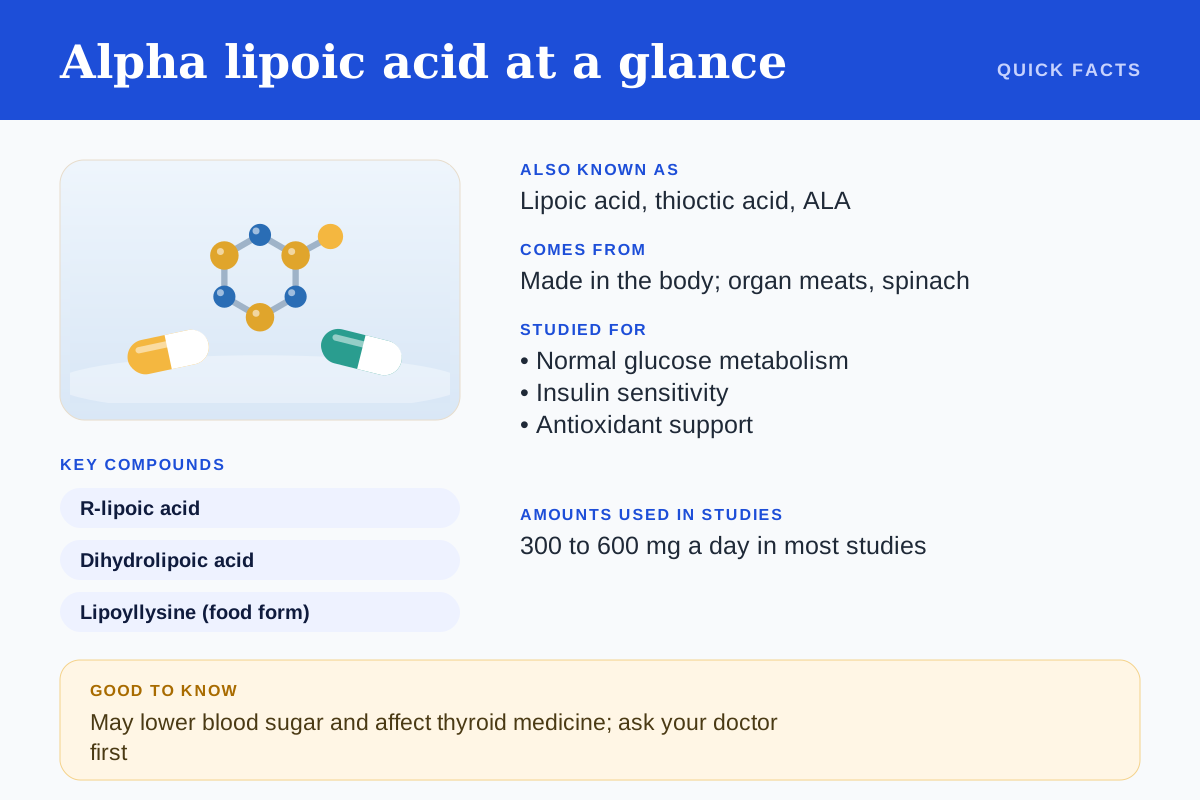
Alpha lipoic acid (often shortened to ALA, and also called lipoic acid or thioctic acid) is a sulfur-containing fatty acid. Scientists first isolated it in the early 1950s. Your liver and other tissues make it from fatty acids and cysteine, and most of it stays attached to enzymes inside the mitochondria, the parts of the cell that produce energy.
One unusual thing about it is that it dissolves in both water and fat. Most antioxidants work in one or the other. Vitamin C works in watery parts of the body, and vitamin E works in fatty cell membranes. Alpha lipoic acid can act in both places, which is part of why researchers became interested in it.
Please do not mix it up with the other ALA, alpha-linolenic acid, the omega-3 fat found in flaxseed and walnuts. They share an abbreviation and nothing else.
How it works in the body
Inside the mitochondria, lipoic acid is a helper (a cofactor) for enzymes that break down glucose and other fuels. Two of these enzyme complexes, pyruvate dehydrogenase and alpha-ketoglutarate dehydrogenase, need it to move the products of sugar breakdown into the energy cycle. Without enough lipoic acid, that step slows down.
When you take it as a supplement, a different picture appears. Free alpha lipoic acid circulates briefly in the blood and is cleared within a few hours. During that window, lab and animal research suggests it may do a few things:
- Neutralize free radicals directly, and help recycle other antioxidants such as vitamin C, vitamin E and glutathione back to their active forms.
- Influence the signals that tell muscle cells to move glucose transporters (GLUT4) to the cell surface, which is how muscle pulls sugar out of the blood.
- Calm some of the oxidative stress that builds up when blood sugar runs high for long periods.
Much of this mechanism work comes from cells and animals. It explains why scientists ran human trials, but it does not prove the same effects happen in every person who takes a capsule.
What the research has looked at
Human studies on alpha lipoic acid and blood sugar are mostly small and short, often a few weeks to a few months. Some trials found modest improvements in fasting glucose and in measures of insulin sensitivity. Others found little change. Pooled reviews of these trials point in a mildly positive direction, with a lot of variation between studies.
It matters who took part. Most trials enrolled adults with type 2 diabetes or with metabolic syndrome, so the results may not apply to healthy people whose blood sugar is already in the normal range. If you take glucose-lowering medicine, keep taking it as prescribed and talk to your doctor before adding alpha lipoic acid or any other supplement.
Alpha lipoic acid has also been studied for nerve comfort in the feet and legs, for weight management and for blood lipids. In Germany it has a long history of medical use, given at higher doses and sometimes by IV under a doctor's care, which is a very different situation from a daily capsule. For the purposes of GLPro, the fair summary is this: alpha lipoic acid has been studied for its role in normal glucose metabolism, and it may support healthy blood sugar levels already in the normal range, but the evidence is still developing.
Food sources
You get a little alpha lipoic acid from food, though the amounts are far smaller than what supplements contain. In food it is mostly bound to protein (as lipoyllysine), so it behaves differently from the free form in capsules.
Sources with the most include organ meats such as kidney, heart and liver. Among plant foods, spinach, broccoli and tomatoes have some, along with smaller amounts in peas, Brussels sprouts and rice bran. Eating these foods is a good habit for many reasons, but no realistic diet will match the hundreds of milligrams used in studies.
Amounts used in studies
Research doses vary a lot. Here is a general picture from the published trials and reviews we checked.
| Use in research | Typical daily amount | Notes |
|---|---|---|
| Glucose metabolism trials | 300 to 600 mg | Most common range, usually for 2 to 6 months |
| Higher-dose trials | 1,200 to 1,800 mg | Split into 2 or 3 doses; more stomach upset reported |
| Normal diet | A few milligrams or less | Bound form, mostly from organ meats and greens |
A few practical points come up again and again. Alpha lipoic acid is absorbed better on an empty stomach, so many studies had people take it 30 minutes or so before a meal. Supplements come in two forms: a mix of R and S forms (the most common and cheapest) and pure R-lipoic acid, which is the form the body makes. Researchers have not settled which works better in people.
Safety and who should ask a doctor first
At the amounts used in most studies, alpha lipoic acid is generally well tolerated by adults. The most common complaints are mild: nausea, heartburn, stomach upset, and occasionally an itchy skin rash. These show up more often at higher doses.
There are some cautions worth knowing about:
- Blood sugar. Because it may lower blood sugar, alpha lipoic acid could add to the effect of insulin or other glucose-lowering medicine. Signs of low blood sugar include shakiness, sweating, fast heartbeat and confusion. Your doctor may want you to check your levels more often.
- Thyroid. Alpha lipoic acid may affect thyroid hormone levels and could interfere with thyroid medicine such as levothyroxine. If you take thyroid medicine, ask your doctor first and expect your levels to be checked.
- Insulin autoimmune syndrome. In rare cases, people taking alpha lipoic acid have developed this condition, in which the body makes antibodies against its own insulin and blood sugar can drop very low. Most reports come from people of East Asian background who carry a specific immune gene type. It usually clears up within a few months after stopping the supplement.
- Thiamine (vitamin B1). People who drink heavily or have a thiamine shortfall should talk to a doctor before taking it.
- Pregnancy and breastfeeding. There is not enough safety data, so it is best avoided unless your doctor says otherwise.
If you take any prescription medicine, especially for blood sugar, blood pressure, blood thinning or thyroid, speak with your doctor or pharmacist before starting alpha lipoic acid, and keep taking your prescribed medicine. A supplement is never a replacement for it.
Why it's in GLPro
According to the GLPro team, alpha lipoic acid is one of five ingredients in the formula, alongside berberine, chromium picolinate, cinnamon bark extract and bitter melon. The likely reason is its role in normal glucose metabolism and its antioxidant activity, which fit the label message of supporting your blood sugar.
What we do not know is how much is in each capsule. The brand has not published a Supplement Facts panel or any ingredient amounts, so we cannot compare GLPro's alpha lipoic acid to the 300 to 600 mg range used in most studies. With five ingredients sharing a single daily capsule, it is reasonable to guess the amount of each is modest, but that is a guess. We have also not seen whether it uses the R form or the mixed form.
If you want our overall verdict on the product, including price, the 60-day money-back guarantee and what we liked and did not like, read our full GLPro review.
The bottom line on alpha lipoic acid
Alpha lipoic acid is a natural compound your cells already use to turn glucose into energy. Supplement studies suggest it may support normal glucose metabolism, although most trials were small and included people with blood sugar concerns, so the results do not translate neatly to everyone. It is usually well tolerated, with stomach upset as the main complaint, but people on glucose-lowering or thyroid medicine need to involve their doctor. A balanced diet, regular movement and good sleep still do most of the work for healthy blood sugar, and a supplement like this can only add a little on top.
Frequently asked questions
Is alpha lipoic acid the same as the ALA in flaxseed?
No. Alpha lipoic acid is a sulfur-containing compound your cells use to make energy. The ALA in flaxseed, chia and walnuts is alpha-linolenic acid, an omega-3 fat. They only share the abbreviation.
When is the best time to take alpha lipoic acid?
Food can reduce how much is absorbed, so many studies gave it on an empty stomach, about 30 minutes before a meal. If it upsets your stomach, ask your doctor or pharmacist how to adjust.
Can alpha lipoic acid affect my thyroid medicine?
It may. Alpha lipoic acid may change thyroid hormone levels and could interfere with thyroid medicine. If you take levothyroxine or another thyroid drug, check with your doctor before starting it and keep taking your prescription.
How much alpha lipoic acid is in GLPro?
We don't know. The GLPro team lists alpha lipoic acid as an ingredient but has not published amounts or a Supplement Facts label. Most research used 300 to 600 mg a day.
Sources
- NIH National Library of Medicine, StatPearls: Alpha-Lipoic Acid
- Linus Pauling Institute, Oregon State University: Lipoic Acid
- European Food Safety Authority (2021): Scientific opinion on alpha-lipoic acid and the risk of insulin autoimmune syndrome
- MedlinePlus: Alpha-lipoic acid
This guide is for general information and is not medical advice. Talk to your doctor before starting any supplement, especially if you take medication.