Somewhere on social media right now, someone is calling berberine "nature's metformin." The nickname spread fast, and it leaves a lot of people with a reasonable question: if a plant extract from the drugstore shelf works like a prescription medicine, why not take the plant?
This guide compares the two fairly. It covers what each one is, how much research stands behind them, the lab pathway they share, side effects, drug interactions, cost and the very different rules they are sold under. The short version is that the comparison is much weaker than the nickname suggests, and nobody should ever stop or replace a prescribed medicine with a supplement.
What metformin is
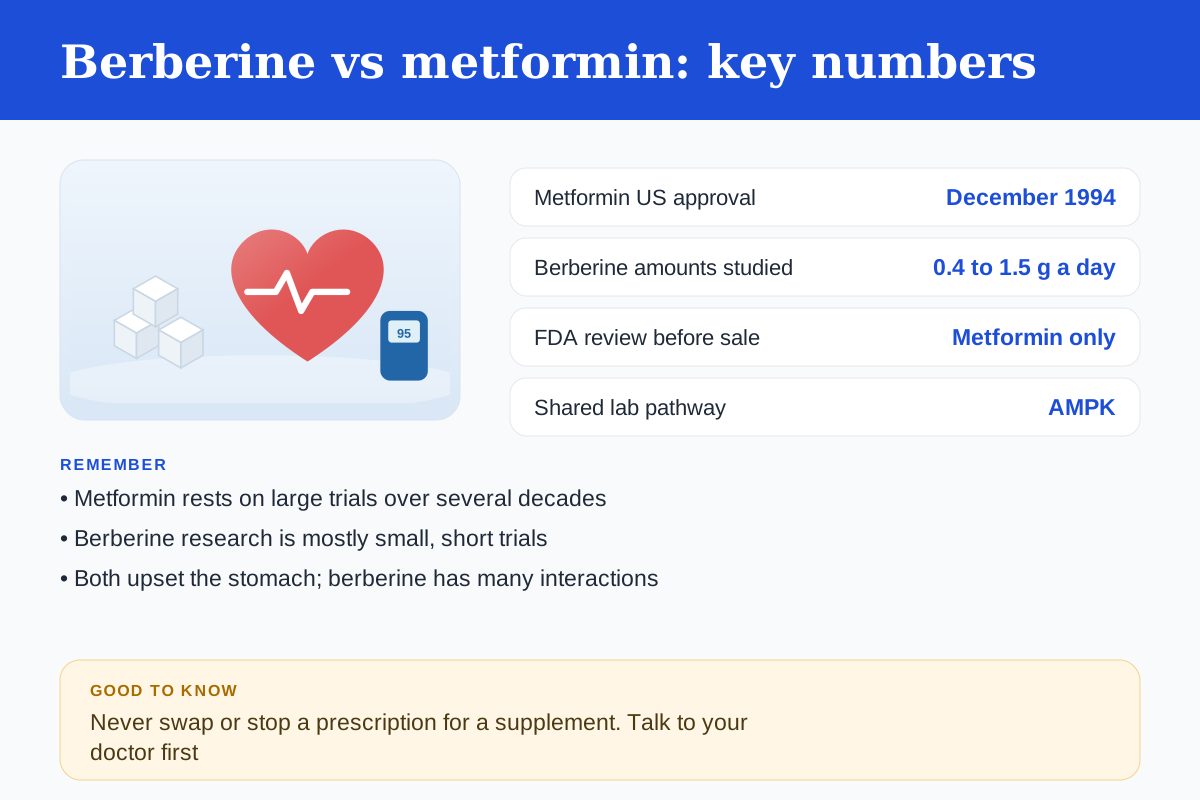
Metformin is a prescription medicine. MedlinePlus describes it as a drug used alone or with other medicines to treat type 2 diabetes, and doctors in many countries prescribe it as a first choice. It has been sold in Europe since the 1950s, and the FDA approved it in the United States in December 1994.
Its main effect is on the liver. Metformin lowers the amount of glucose the liver releases into the blood and helps the body respond better to its own insulin. It has been tested in large clinical trials over several decades, including the NIH-funded Diabetes Prevention Program, and millions of people take it every day under medical supervision. Doctors pick the dose, check kidney function before and during treatment, and adjust the plan over time.
What berberine is
Berberine is a bright yellow compound found in the roots, stems and bark of several plants, including goldenseal, barberry, Oregon grape and Chinese goldthread. It has a long history in traditional Chinese and Ayurvedic practice. In the US it is sold as a dietary supplement, usually as berberine hydrochloride in capsules.
Researchers have studied berberine for normal glucose metabolism, blood lipids and body weight. MedlinePlus notes that adults have most often used 0.4 to 1.5 grams a day by mouth, for up to two years, in research. Many trials split the amount into two or three doses with meals, partly because berberine is poorly absorbed and passes through the body quickly.
The shared pathway: AMPK
The "nature's metformin" idea comes mostly from lab research. In cell and animal studies, both berberine and metformin activate an enzyme called AMPK (AMP-activated protein kinase). AMPK works like an energy sensor inside cells. When it switches on, cells tend to take up more glucose, burn more fat for fuel and make less new glucose and fat. Exercise switches on the same enzyme.
A shared pathway in a lab dish is a starting point, though, and it says little about how two substances compare in people. Berberine also acts in other ways, including effects on gut bacteria and on gut hormones, and metformin has several actions beyond AMPK that scientists are still sorting out.
How the research compares
This is where the gap is widest. Metformin's evidence comes from large, long, well-controlled trials with thousands of participants and decades of follow-up on safety. Berberine's evidence comes mostly from smaller and shorter trials. Many were run in China, many lasted a few months, and reviews of this research often point out small sample sizes and mixed study quality.
A handful of small trials have compared berberine with metformin head to head, and some reported similar short-term changes in blood glucose. Those trials enrolled adults who already had type 2 diabetes, were brief, and were not designed to answer whether berberine can safely stand in for a medicine over years. Results in one small group of people may not apply to you. If you have diabetes or take glucose-lowering medicine, keep taking it as prescribed and talk to your doctor before adding berberine or any supplement.
Side effects: both can upset the stomach
The two do share one practical trait: digestive side effects. With metformin, diarrhea, nausea, gas and stomach upset are common, especially in the first weeks, which is why doctors often start low and raise the dose slowly. With berberine, the most reported problems are constipation, diarrhea, gas and stomach upset.
Beyond the gut, the lists diverge. Metformin carries a boxed warning about lactic acidosis, a rare but serious condition, and people with kidney disease are usually told not to take it. Long-term use can lower vitamin B12 levels, so doctors may check B12 now and then. Berberine is considered likely unsafe in pregnancy and while breastfeeding, because it can cross the placenta and pass into breast milk, and it has been linked to a dangerous form of jaundice (kernicterus) in newborns. NCCIH also lists pregnancy and breastfeeding as reasons to avoid it.
Interactions and the danger of combining them
Berberine affects liver enzymes that break down many medicines, so it can raise or lower the levels of other drugs in the blood. Cyclosporine is a well-known example. MedlinePlus also says berberine might increase the amount of metformin in the body, which could increase its effects and side effects.
Taking both can also stack the glucose-lowering effect and raise the chance of blood sugar dropping too low, especially in people also on insulin or a sulfonylurea. Berberine may add to blood pressure medicine and may slow blood clotting, which matters for anyone on a blood thinner. These are the reasons to tell your doctor or pharmacist about every supplement you take, berberine included.
Cost, regulation and quality
| Metformin | Berberine | |
|---|---|---|
| What it is | Prescription medicine | Dietary supplement |
| FDA review before sale | Yes, for safety and effectiveness | No, supplements are not approved before sale |
| Evidence in people | Large trials over decades | Mostly small, short trials |
| Shared lab pathway | Activates AMPK | Activates AMPK |
| Common side effects | Diarrhea, nausea, stomach upset | Constipation, diarrhea, stomach upset |
| Serious concerns | Rare lactic acidosis, low B12 | Unsafe in pregnancy and for newborns, many drug interactions |
| Dose control | Set and adjusted by your doctor | Chosen by the buyer; strength varies by brand |
| Usual cost | Generic, often covered by insurance | Paid out of pocket |
| Legal claims | Approved to treat a disease | Cannot claim to treat any disease |
Generic metformin is one of the cheaper prescription medicines and is often covered by insurance. Berberine is paid for out of pocket, and a month of a standalone berberine product can cost more than a month of generic metformin.
Regulation is the bigger difference. A prescription drug must show the FDA that it is safe and effective before it is sold, and each batch must contain what the label says. Supplements reach shelves without that review. The maker is responsible for safety and label accuracy, and independent tests of supplements have found products with more or less of an ingredient than the label claims. If you do buy berberine, a third-party seal such as USP Verified or NSF gives some extra assurance that the bottle holds what it says.
Why berberine is not a substitute
Metformin has decades of large trials, a dose your doctor sets and monitors, known long-term safety and a legal approval to treat a disease. Berberine has a promising but small body of research, a dose you choose yourself, uneven product quality and real interaction risks.
Stopping a prescribed medicine on your own can let blood sugar rise without you noticing, and the damage from high glucose builds slowly. If cost, side effects or a wish to try something natural is pushing you toward a switch, say so to your doctor. There may be other options, such as an extended-release tablet that is easier on the stomach. Never swap, stop or reduce a prescription medicine because of something you read online, including this article.
If you are curious about berberine, bring these to your next appointment so your doctor can give advice that fits you:
- the exact product name, the amount of berberine per capsule and how many capsules you plan to take
- a full list of your prescriptions, over-the-counter medicines and other supplements
- your recent glucose readings or lab results, if you track them
- whether you are pregnant, breastfeeding or planning a pregnancy
- what you hope to get from it, so your doctor can tell you whether the research supports that goal
A pharmacist can also run an interaction check in a few minutes, usually at no charge.
Where GLPro fits
GLPro is a once-a-day dietary supplement, and according to the GLPro team berberine is one of its listed ingredients, along with chromium, cinnamon bark, alpha lipoic acid and bitter melon. The company does not publish how much berberine is in each capsule, so it can't be compared with the amounts used in research, and it is in no way a replacement for metformin or any other medicine. In May 2026 the FDA also sent the company an advisory letter about its marketing. We cover the formula, the letter and the 60-day refund in our full GLPro review.
Frequently asked questions
Is berberine really nature's metformin?
No. The nickname comes from lab studies showing that both activate an enzyme called AMPK. Metformin is a prescription medicine tested in large trials over decades, while berberine is a supplement with mostly small, short studies. A shared pathway in the lab does not make them interchangeable.
Can I stop my prescription and take berberine instead?
No. Never stop, reduce or swap a prescribed medicine for a supplement. If you take metformin for type 2 diabetes or any other reason, keep taking it as directed and talk to your doctor about any concerns, including cost or side effects.
Is it safe to take berberine and metformin together?
Only your doctor can answer that for you. Berberine may raise the amount of metformin in the body and can add to its glucose-lowering effect, which raises the risk of low blood sugar. It also interacts with many other medicines. Ask your doctor or pharmacist before combining them.
Which has more side effects?
Both commonly cause digestive problems such as diarrhea or stomach upset. Metformin has a rare but serious risk of lactic acidosis and can lower vitamin B12 over time. Berberine can cause constipation, is not safe in pregnancy or while breastfeeding, and interacts with many drugs.
Sources
- MedlinePlus: Metformin
- MedlinePlus: Berberine
- NCCIH: Berberine
- NIDDK: Diabetes Prevention Program
- FDA: Questions and answers on dietary supplements
This guide is for general information and is not medical advice. Talk to your doctor about your own numbers and treatment.