Bitter melon looks like a pale green, warty cucumber, and it tastes exactly like its name. In kitchens across India, China, the Philippines, Okinawa and the Caribbean it is an everyday vegetable, sliced into stir-fries, stuffed, or pressed into a sharp green juice.
It has also been used in traditional medicine for a long time, which is why scientists started testing it for blood sugar support. Bitter melon is one of the five ingredients listed by the GLPro team. Here is what it is, what the studies found, how much was used, and the safety warnings that matter most.
What bitter melon is
Bitter melon (Momordica charantia) is a climbing vine in the gourd family, related to cucumbers, squash and melons. It grows in warm, humid climates and is thought to have originated in tropical Asia, possibly India. Today it is grown across Asia, Africa, South America and the Caribbean.
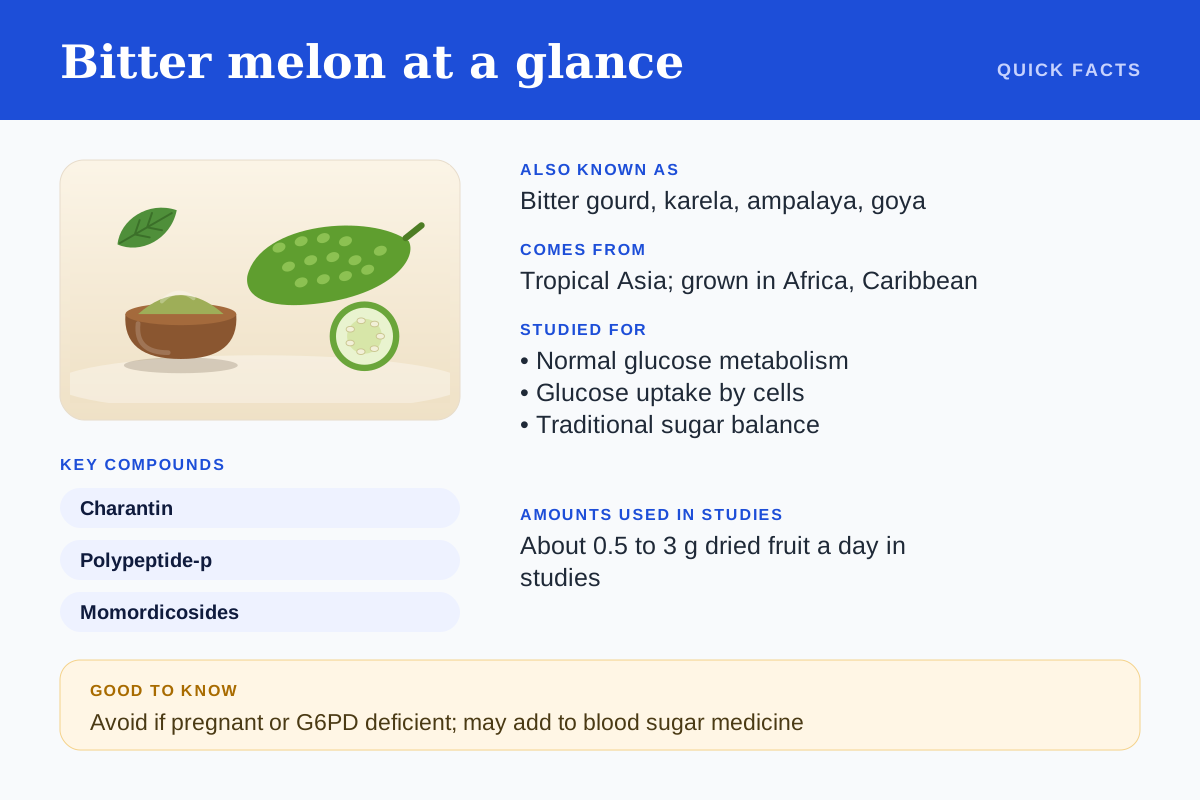
It goes by many names. In India it is karela, in the Philippines ampalaya, in Okinawa goya, and in English you will also see bitter gourd or balsam pear. The fruit is usually picked green, while it is still firm. As it ripens it turns orange and splits open to show seeds wrapped in a bright red pulp.
Supplements are usually made from the dried fruit, sometimes with seeds, either ground into a powder or concentrated into an extract.
Traditional use and food
In Ayurveda and traditional Chinese medicine, bitter melon has long been given for sugar balance, digestion and "cooling" the body in hot weather. Folk healers in Africa, Latin America and the Caribbean used the leaves and fruit in teas for similar reasons.
As a food it is cooked many ways. Okinawans fry it with tofu, egg and pork in a dish called goya champuru. Indian cooks often salt the slices first to pull out some bitterness, then fry them with onion and spices or stuff the whole gourd. Chinese cooks pair it with black bean sauce or put it in soups. Eaten as a vegetable in normal portions, it has been part of the diet of millions of people for generations. A cup of cooked bitter melon is low in calories and gives you vitamin C, folate and fiber.
The compounds behind it
Bitter melon contains several groups of plant compounds that researchers have looked at for their effects on glucose:
- Charantin, a mixture of plant steroids that lowered blood sugar in early animal studies.
- Polypeptide-p (sometimes called plant insulin), a protein that acts somewhat like insulin in lab tests.
- Cucurbitane-type triterpenoids, including momordicosides, which give the fruit its bitterness.
- Vicine, a compound found mainly in the seeds, which matters for safety (more on that below).
The amounts of these compounds vary with the variety, the ripeness of the fruit and how the supplement is made. That is one reason research results are hard to compare.
How it may work
Lab and animal research suggests bitter melon may influence blood sugar through several routes. Some compounds appear to help cells take up glucose. Others seem to activate AMPK, an enzyme that acts like a fuel sensor in the cell and is also involved in how exercise affects glucose use. There is some evidence that bitter melon may slow how quickly sugars are absorbed from the gut, and polypeptide-p may mimic insulin in a limited way.
These ideas come mostly from test tubes and animals. They explain why researchers became interested, but they do not show how much of that happens when a person swallows a capsule of dried fruit powder.
What human studies show
Human research on bitter melon is smaller and less consistent than for some other ingredients. Several short trials, often a few weeks to three months long, found modest drops in fasting glucose. Others found no meaningful difference from a placebo. Reviews that pooled these trials have generally concluded the evidence is promising but not strong, partly because studies were small, used different preparations and lasted only a short time.
Most of these trials enrolled adults with type 2 diabetes or prediabetes, so results may not apply to healthy people whose blood sugar is already normal. If you take glucose-lowering medicine, keep taking it as prescribed and talk to your doctor before adding bitter melon or any other supplement.
A fair way to put it: bitter melon has been studied for its role in normal glucose metabolism and may support healthy blood sugar levels already in the normal range, but scientists want larger and longer trials before drawing firm conclusions.
Amounts used in studies
No standard dose has been established, and preparations differ a lot. This table gives a general idea of what has been used.
| Form | Amounts reported in research | Notes |
|---|---|---|
| Dried fruit powder in capsules | About 0.5 to 3 g a day | Most common form in trials, usually for 1 to 3 months |
| Standardized extract | A few hundred mg a day | Strength depends on how concentrated it is |
| Fresh juice or cooked fruit | Varies widely | Traditional use, hard to measure |
Because the strength of products varies so much, you cannot easily translate a study dose to a supplement on a store shelf. Taking more is not safer or better, especially with this ingredient.
If you buy a bitter melon product on its own, look for a label that names the plant part used (fruit, seed or leaf), says whether it is a powder or an extract, and lists the amount per serving. A third-party testing seal from a group such as USP or NSF tells you the product was checked for what is inside it and for contaminants, though it says nothing about whether the product works. Herbal products are not reviewed by the FDA before they reach shelves, so these details are the best quality signal you have.
Safety and who should avoid it
As a cooked vegetable in normal amounts, bitter melon is generally considered safe for most adults. Concentrated supplements are different, and there are real cautions:
- Low blood sugar. Bitter melon may lower blood sugar, and combined with insulin or other glucose-lowering medicine it could drop too low. Watch for shakiness, sweating, dizziness or confusion, and talk to your doctor before trying it.
- Pregnancy. Do not use bitter melon supplements if you are pregnant or trying to become pregnant. Compounds in the fruit, seeds and juice have triggered bleeding and miscarriage in animal studies. With no good safety data for breastfeeding, it is best avoided then too.
- G6PD deficiency. People with this inherited enzyme shortfall should avoid bitter melon. The seeds contain vicine, which has been linked to favism-like reactions, a breakdown of red blood cells that can cause tiredness, fever, headache and stomach pain.
- Children. Keep bitter melon supplements and teas away from children. Serious low blood sugar has been reported in young children given bitter melon tea.
- Stomach. Diarrhea, stomach pain and nausea are the most common complaints, more often at higher doses.
- Surgery. Because it may affect blood sugar, stop it at least two weeks before a scheduled operation unless your surgeon says otherwise.
If you take any prescription medicine, particularly for blood sugar, blood pressure or blood thinning, check with your doctor or pharmacist first, and keep taking the medicine your doctor prescribed.
Why it's in GLPro
According to the GLPro team, bitter melon is one of five ingredients in the formula, together with berberine, chromium picolinate, cinnamon bark extract and alpha lipoic acid. Its long traditional use for sugar balance and the early research on glucose metabolism make it a common choice in blood sugar support blends.
The catch is that we do not know how much bitter melon GLPro contains, whether it is a whole fruit powder or an extract, or whether seeds are included. The brand has not published amounts or a Supplement Facts label. With five ingredients in one small daily capsule, the amount of bitter melon is probably well below the gram-level doses used in many studies, though we cannot confirm that. People with G6PD deficiency or who are pregnant should take that uncertainty seriously and talk to a doctor before trying the product.
For our verdict on GLPro as a whole, including the price, the 60-day money-back guarantee and what we would like the brand to disclose, see our full GLPro review.
Frequently asked questions
What does bitter melon taste like?
Very bitter, as the name says. The bitterness comes from compounds called cucurbitane triterpenoids. Cooks often salt the slices and rinse them, or pair the fruit with egg, tofu, pork or spices to soften the taste. Capsules avoid the taste altogether.
Is it safe to eat bitter melon as a vegetable?
For most adults, eating cooked bitter melon in normal food portions is considered safe. Pregnant women, young children and people with G6PD deficiency should avoid it, and anyone on glucose-lowering medicine should ask their doctor.
Who should not take bitter melon supplements?
Avoid them if you are pregnant, trying to conceive, breastfeeding or have G6PD deficiency, and keep them away from children. If you take blood sugar, blood pressure or blood thinning medicine, talk to your doctor first and keep taking your prescription.
How much bitter melon is in GLPro?
We don't know. The GLPro team lists bitter melon as an ingredient but has not published amounts, the form used or a Supplement Facts label. Studies have used roughly 0.5 to 3 grams of dried fruit a day.
Sources
- MedlinePlus: Bitter melon
- Memorial Sloan Kettering Cancer Center, About Herbs: Bitter Melon
- Drugs.com Natural Product Sources: Bitter Melon
This guide is for general information and is not medical advice. Talk to your doctor before starting any supplement, especially if you take medication.