Chromium is a mineral your body needs only in tiny amounts, measured in micrograms. It has been sold as a blood sugar supplement for decades, usually as chromium picolinate, and it shows up in a lot of formulas aimed at people watching their glucose.
The research on it is more mixed than the marketing suggests. Below we go through where chromium comes from, what it seems to do with insulin, what the studies found, how much researchers used, the safety points worth knowing and why it is one of GLPro's listed ingredients.
What chromium is
Chromium is a metal that exists in a few chemical forms. The form in food and supplements is trivalent chromium (chromium 3). The other common form, hexavalent chromium (chromium 6), is an industrial pollutant from processes like metal plating and leather tanning, and it is toxic. Supplements do not contain it, and the two shouldn't be confused.
Trivalent chromium is a trace mineral, which means the body uses very small amounts. For years it was considered an essential nutrient because it seemed to help insulin do its job. That view has softened. The European Food Safety Authority concluded in 2014 that there was no convincing evidence that chromium is essential, and the US Office of Dietary Supplements (ODS) notes that the Food and Nutrition Board last evaluated chromium in 2001. The US still has intake guidelines, listed further down.
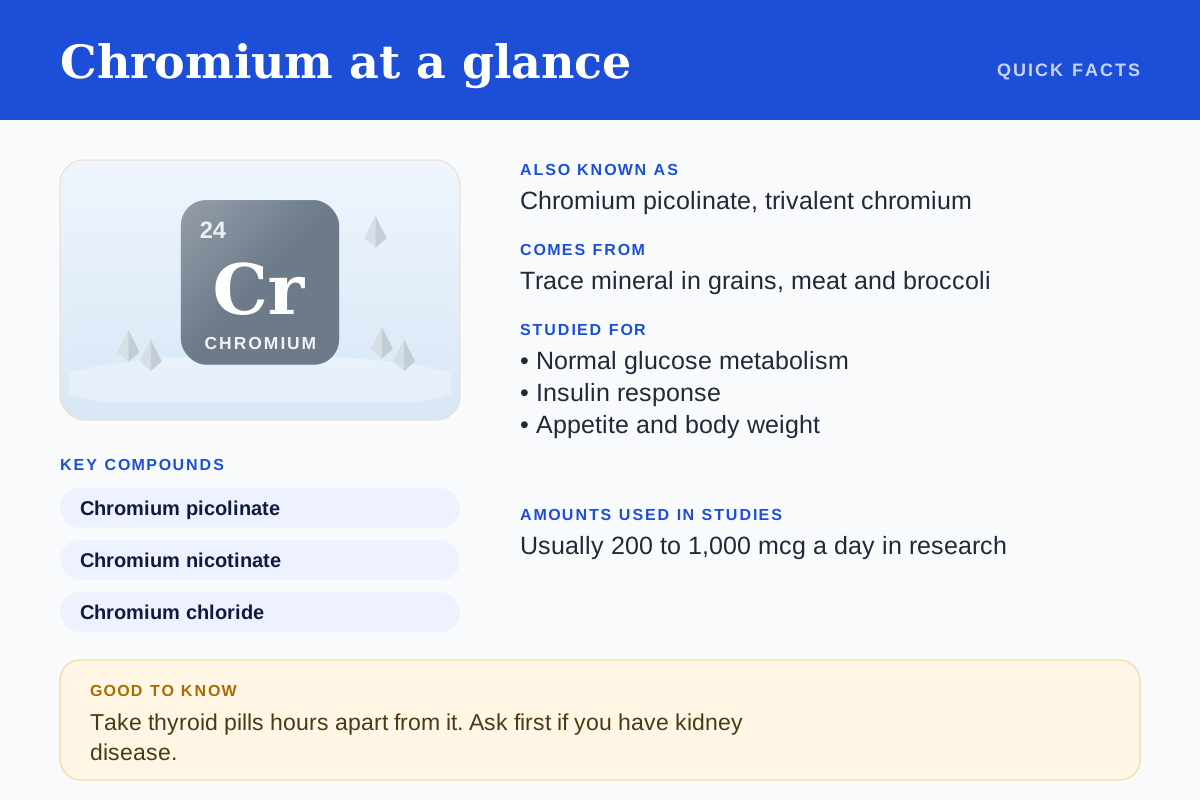
In supplements, chromium is attached to another molecule to help the body absorb it. Chromium picolinate, chromium nicotinate (also sold as chromium polynicotinate) and chromium chloride are the most common forms. ODS says absorption of these forms is similar. GLPro's listed form, according to the GLPro team, is chromium picolinate, the one used in most published trials.
Food sources
Many everyday foods contain small amounts of chromium, but the exact numbers are hard to pin down, because the amount in plants depends on the soil and water where they grew. Processing and cooking in stainless steel can also add a little. Good sources include:
- Broccoli and green beans
- Potatoes
- Whole grains and high fiber bran cereals
- Beef, poultry, fish and egg yolks
- Apples and bananas
- Brewer's yeast
- Coffee, and some beers and red wines
Most US adults are thought to get enough chromium from a mixed diet, and deficiency in healthy people is very rare. The few clear cases of deficiency were in hospital patients fed only through an IV for long periods, whose high blood sugar improved when chromium was added to their IV solution.
How much chromium adults need
Because the evidence wasn't strong enough to set a Recommended Dietary Allowance, the US uses Adequate Intake (AI) values. These are estimates based on what healthy people typically eat. Supplement amounts are much higher.
| Group or use | Amount per day |
|---|---|
| Men 19 to 50 (AI) | 35 mcg |
| Women 19 to 50 (AI) | 25 mcg |
| Men over 50 (AI) | 30 mcg |
| Women over 50 (AI) | 20 mcg |
| Daily Value on supplement labels | 35 mcg |
| Typical range in blood sugar studies | 200 to 1,000 mcg |
No upper limit has been set for chromium, because toxic levels have not been seen from food or from longer use of supplements in studies. That doesn't mean high doses are risk free, as the safety section explains.
How chromium works with insulin
Insulin is the hormone that tells your cells to take in glucose after a meal. It works by attaching to receptors on the cell surface, which sets off a chain of signals inside the cell. Chromium appears to help that signal along.
One leading theory involves a small protein that binds chromium, sometimes called chromodulin. When insulin rises, the idea goes, chromium moves into cells and helps keep the insulin receptor active for longer, so the same amount of insulin has a stronger effect. Researchers still argue about the details, and this model has not been fully confirmed in people.
What is clearer is the IV feeding observation above: when people truly lacked chromium, adding it back improved how their bodies handled glucose. Whether extra chromium helps someone who already gets enough is a separate question, and that is where the research gets murky.
What the research shows
Chromium has been studied for blood sugar, insulin response, cholesterol, appetite and body weight. The results have been inconsistent. Some trials found small improvements in fasting glucose or insulin levels, while others found no change at all. Reviews of the research point to differences in the form and dose of chromium, how long people took it and who the participants were.
Many of these trials enrolled adults with type 2 diabetes, often people whose blood sugar was not well controlled, so the results may not apply to healthy adults with normal numbers. If you take insulin or another glucose-lowering medicine, keep taking it and talk with your doctor before adding chromium, since it may add to the effect of those drugs.
In 2005 the FDA reviewed the evidence for chromium picolinate and allowed only a heavily qualified claim, describing the science behind it as highly uncertain. For weight, a meta-analysis cited by the Harvard T.H. Chan School of Public Health used a median of 400 mcg a day and found the effect on body weight was very small.
Some trials paired chromium with biotin or with plant extracts, which makes it hard to tell which part of the mix did the work. The same problem applies to any multi ingredient formula, GLPro included, since a blend of five ingredients has not been tested the way single ingredients have.
For a healthy adult, chromium supports normal glucose metabolism as part of a balanced diet, and extra chromium may support healthy blood sugar levels already in the normal range for some people. Any effect in the studies was modest, so it makes sense to expect a small nudge at most, alongside the basics of diet, activity and sleep.
Safety and interactions
At the amounts used in most studies, chromium picolinate has been well tolerated. Reported side effects include headache, stomach upset, trouble sleeping and mood changes, though these are uncommon. A small number of case reports have linked high doses, in some cases 1,200 to 2,400 mcg a day for months, to kidney or liver damage. Case reports can't prove cause, but they are a reason to stay within studied amounts.
Points to discuss with your doctor
- Insulin and other glucose-lowering medicine. Chromium may add to their effect and push blood sugar lower than expected.
- Levothyroxine. Chromium can reduce how much of this thyroid medicine your body absorbs. MedlinePlus advises taking levothyroxine 30 minutes before or 3 to 4 hours after chromium.
- Kidney or liver disease. Ask first, since the case reports above involved those organs.
- Corticosteroids and some other medicines, which can interact with chromium or change how the body handles it.
- Pregnancy and breastfeeding. Stick with the amounts your doctor or prenatal vitamin provides.
If you take any prescription medicine, including drugs for blood sugar, blood pressure or blood thinning, check with your doctor or pharmacist before adding a chromium supplement, and keep taking your prescribed medicine.
Why chromium is in GLPro
According to the GLPro team, chromium picolinate is one of five listed ingredients, alongside berberine, cinnamon bark extract, alpha lipoic acid and bitter melon. Chromium is a common choice for blood sugar formulas because it is cheap, small enough to fit easily into a capsule and has a long track record of safety at moderate doses. Its connection to insulin signaling makes it a logical partner for the other four.
Unlike berberine, a meaningful chromium dose weighs almost nothing (200 mcg is one fifth of a milligram), so space in the capsule isn't a problem. The catch is that we don't know the amount. The brand doesn't publish a Supplement Facts label or ingredient amounts, so we can't tell you whether GLPro's chromium is closer to the daily AI or to the higher amounts used in research.
If you already take a multivitamin, it probably contains some chromium too, so it is worth adding up your sources. And if you take levothyroxine, plan your timing around the thyroid pill no matter which chromium product you use. For our verdict on the full formula, its price and its 60-day money-back guarantee, see our full GLPro review.
Frequently asked questions
Do I need a chromium supplement?
Most adults get enough chromium from a mixed diet that includes foods like broccoli, whole grains, potatoes and meat, and true deficiency is rare. A supplement is a personal choice, and it's best made with your doctor if you take any medicine.
What is chromium picolinate?
It is trivalent chromium bound to picolinic acid, a compound that helps the mineral get absorbed. It is the most studied supplement form, and it is the form the GLPro team lists.
Can I take chromium with my thyroid medicine?
Chromium can reduce how much levothyroxine your body absorbs. MedlinePlus advises taking levothyroxine 30 minutes before or 3 to 4 hours after chromium. Ask your doctor or pharmacist to help you set a schedule.
Is the chromium in supplements the same as toxic chromium?
No. Supplements and food contain trivalent chromium. The toxic form, hexavalent chromium, comes from industrial pollution and is not used in supplements.
Sources
- NIH Office of Dietary Supplements: Chromium fact sheet
- MedlinePlus: Chromium
- Harvard T.H. Chan School of Public Health, The Nutrition Source: Chromium
- European Food Safety Authority: Scientific opinion on dietary reference values for chromium (2014)
- GLPro official site (tryglpro.com): listed ingredients
This guide is for general information and is not medical advice. Talk to your doctor before starting any supplement, especially if you take medication.