Standing in a grocery aisle, it is hard to know which loaf, cereal or snack bar is the better pick for your blood sugar. Labels shout about protein, keto, whole grain and no added sugar, and half of those words tell you very little about what happens after you eat.
This guide sorts everyday foods by what they actually do: which ones slow digestion, which ones hit the blood fast, and how to put them together. The numbers come from MedlinePlus, the Harvard T.H. Chan School of Public Health Nutrition Source and the American Diabetes Association. If you have diabetes or think you might, see your doctor, keep taking your prescribed medicine, and ask your care team or a dietitian before big changes to how you eat, because food changes can shift how some medicines work.
Fiber first: how much you need and where to find it
Fiber is the part of plant food your body can't digest. It slows the speed at which starch and sugar reach the blood, and it keeps you full for longer. Most American adults eat far less than the targets, so this is usually the easiest place to start.
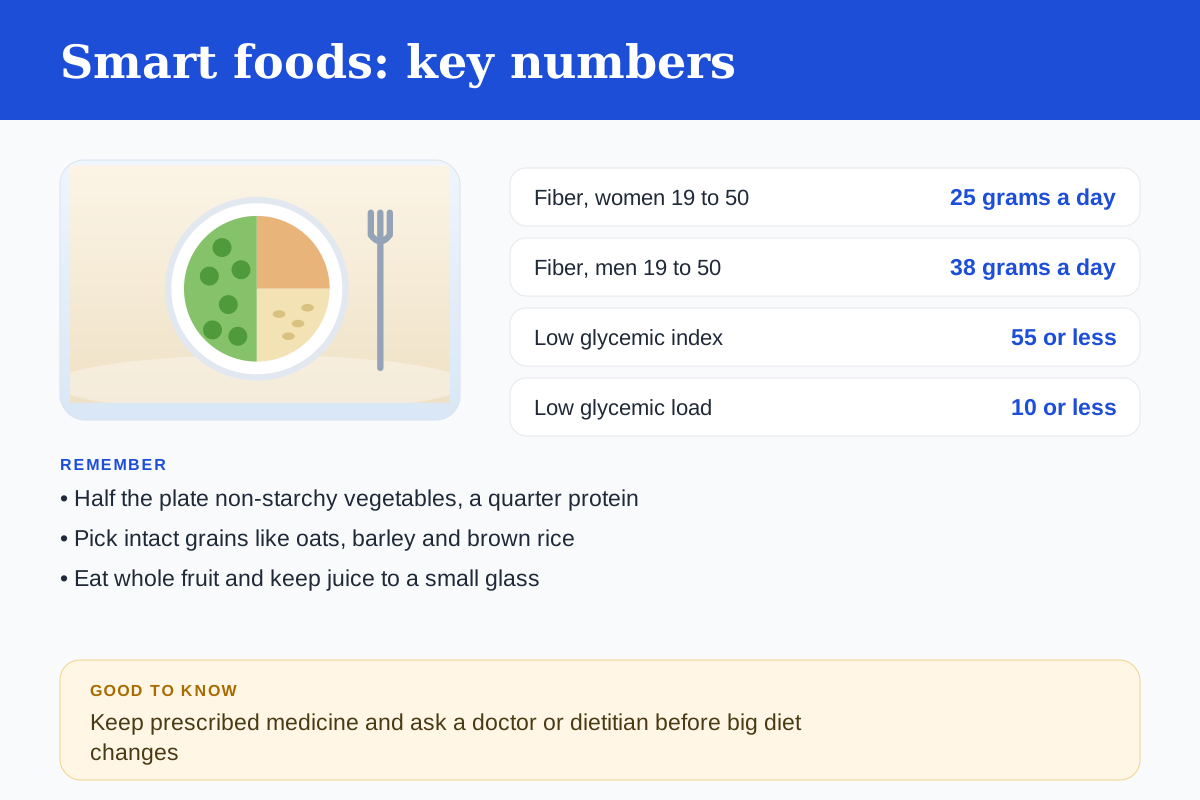
The standard US targets are 25 grams a day for women and 38 grams for men aged 19 to 50. After 50, the Institute of Medicine figures quoted by Harvard drop to 21 grams for women and 30 grams for men. Another way to think about it is about 14 grams of fiber for every 1,000 calories you eat, the rule used in the Dietary Guidelines for Americans.
Non-starchy vegetables
These are the vegetables you can pile on without much thought: leafy greens, broccoli, cauliflower, cabbage, zucchini, asparagus, green beans, mushrooms, peppers, onions, tomatoes, cucumbers and Brussels sprouts. They carry fiber, water and very little starch. Frozen bags without sauce are just as good as fresh and save you the chopping. Potatoes, corn and peas are vegetables too, but they are starchy, so count them with the grains on your plate.
Beans, lentils and chickpeas
Legumes are unusual because they bring fiber and protein in the same bite, which makes them one of the gentlest carbohydrate foods there is. Black beans, kidney beans, pinto beans, lentils, split peas, chickpeas and edamame all count. Canned beans are fine; rinse them in a strainer to wash off some of the salt.
Raise fiber over two or three weeks and drink more water as you go. A sudden jump is the usual cause of gas and bloating.
Whole grains versus refined grains
A whole grain still has its bran, germ and starchy center. Refining strips the bran and germ, which removes most of the fiber and leaves starch that digests quickly. The Harvard Nutrition Source notes that refined grains such as white bread and white rice have a higher glycemic index than minimally processed whole grains.
Not all whole grain products are equal, though. Intact or lightly processed grains, such as steel-cut or rolled oats, barley, brown rice, quinoa, bulgur and farro, are digested more slowly than whole wheat flour ground fine and baked into soft bread. So a bowl of barley soup will usually treat your blood sugar more gently than a slice of whole wheat sandwich bread, even though both are whole grain.
When you buy packaged grains, read the ingredient list instead of the front of the box:
- The first ingredient should say whole, as in whole wheat, whole oats or whole grain corn.
- Words like multigrain, wheat flour, enriched flour or made with whole grains don't promise much whole grain.
- Look for a few grams of fiber per serving and little or no added sugar.
MyPlate's simple goal is to make at least half your grains whole.
Protein and healthy fat at every meal
Protein and fat don't raise blood sugar much on their own, and they slow how fast the stomach empties. Adding them to a meal that contains starch tends to flatten the rise that follows. They also keep you full, which makes the mid-afternoon vending machine less tempting.
Good protein choices include eggs, fish, chicken, turkey, lean beef or pork, Greek yogurt, cottage cheese, tofu, tempeh and the beans above. For fat, lean on olive oil, avocado, nuts, seeds and fatty fish such as salmon or sardines. Butter, cheese and fatty meats are better in small amounts because of their saturated fat, which matters for heart health.
Breakfast is where protein most often goes missing. Toast with jam, a bagel or a bowl of sweetened cereal is almost pure starch. Adding two eggs, a cup of Greek yogurt or a spoon of peanut butter changes the meal without much effort.
Fruit and drinks
Whole fruit contains natural sugar, but it comes packed in fiber and water, and you have to chew it. Juice removes most of the fiber and lets you drink the sugar of several pieces of fruit in under a minute. That is why an orange and a glass of orange juice behave so differently, even though they come from the same tree.
Berries, apples, pears, oranges, cherries, peaches and plums are easy everyday picks. Bananas, grapes and mango are fine too; just keep the portion modest and pair them with yogurt or nuts. Dried fruit is concentrated, so a small handful counts as a full serving. Canned fruit is fine if it is packed in water or its own juice instead of syrup.
For drinks, water, sparkling water, unsweetened tea and black coffee or coffee with milk are the everyday choices. The Harvard Nutrition Source suggests limiting juice to one small glass a day. Regular soda, sweet tea, sports drinks and sweetened coffee drinks are the fastest way to send sugar into the blood, because there is no fiber, fat or protein to slow them down.
Glycemic index and glycemic load in plain words
The glycemic index, or GI, ranks carbohydrate foods by how fast they raise blood sugar compared with pure glucose, which scores 100. The Harvard Nutrition Source groups them like this: 55 or less is low, 56 to 69 is medium, and 70 or more is high.
GI has a blind spot: it is measured using a fixed amount of carbohydrate, not a normal serving. Some foods score high on GI but contain so little carbohydrate in a typical portion that they barely move your blood sugar. Glycemic load, or GL, fixes this by combining how fast a food acts with how much carbohydrate a real serving contains.
| Measure | What it tells you | Low | High |
|---|---|---|---|
| Glycemic index | How fast a food's carbohydrate raises blood sugar | 55 or less | 70 or more |
| Glycemic load | Speed plus the amount in a normal serving | 10 or less | 20 or more |
You don't need to memorize scores. In practice, both numbers point to the same habits: choose intact grains, beans, whole fruit and vegetables most of the time, keep refined starch and sugary drinks small, and remember that portion size counts as much as the food itself. Harvard also notes that the total amount of carbohydrate you eat is a strong predictor of what happens to your blood sugar.
Using the plate method in real meals
The ADA's plate method gives you proportions without counting: half the plate non-starchy vegetables, a quarter protein, a quarter carbohydrate food, on a plate about 9 inches across. Real meals don't always come on a plate, so here is how it translates.
- For a bowl, start with a bed of greens or roasted vegetables, add a palm-sized portion of protein, and keep the rice or noodles to about a quarter of the bowl.
- For a sandwich, use whole grain bread, fill it with protein and vegetables, and swap the chips for raw vegetables or a piece of fruit.
- For pasta night, toss a smaller portion of pasta with a large amount of vegetables and some chicken, shrimp or beans.
- At a restaurant, ask for a double side of vegetables in place of fries, or box half the starch before you start.
| Instead of | Try | Why |
|---|---|---|
| Sweetened cereal | Rolled oats with berries and nuts | Intact grain plus fiber and fat |
| White rice | Brown rice, barley or half rice, half cauliflower rice | More fiber, smaller starch portion |
| Orange juice | A whole orange and water | Fiber stays in, sugar comes slower |
| Flavored yogurt | Plain Greek yogurt with fruit | More protein, less added sugar |
| Chips | Nuts, popcorn or hummus with vegetables | Fat, protein or fiber in the snack |
| Soda | Sparkling water with lemon or lime | No liquid sugar |
| White bread | Bread with a whole grain first ingredient | More fiber per slice |
| Creamy pasta | Smaller pasta portion with vegetables and beans | Starch shrinks, fiber grows |
A sample day of meals
This is one example, not a prescription. Portions depend on your size, activity and any advice from your doctor or dietitian.
- Breakfast: a vegetable omelet with spinach, peppers and onions, a slice of whole grain toast and a handful of strawberries.
- Lunch: lentil and vegetable soup, a side salad with olive oil dressing and a small piece of cheese.
- Snack: plain Greek yogurt with a spoon of chia seeds, or a pear with a small handful of almonds.
- Dinner: baked salmon, a big tray of roasted broccoli and carrots, and a half cup of quinoa or barley.
- Drinks: water through the day, coffee or tea without sugar, sparkling water with dinner.
A blood sugar friendly shopping list
Keeping these at home makes the choices above the easy default:
- Vegetables: salad greens, frozen broccoli and green beans, cabbage, carrots, peppers, onions, canned tomatoes with no salt added.
- Legumes: canned black beans and chickpeas, dry lentils, frozen edamame, hummus.
- Grains: rolled or steel-cut oats, barley, brown rice, quinoa, whole grain bread and tortillas.
- Protein: eggs, canned tuna or salmon, chicken, tofu, plain Greek yogurt, cottage cheese.
- Fats: olive oil, avocados, unsalted nuts, peanut butter with no added sugar, chia and ground flaxseed.
- Fruit: apples, pears, oranges, frozen berries, a few bananas.
- Flavor: herbs, spices, vinegar, lemons, garlic, mustard.
Where GLPro fits
Some readers like to add a supplement on top of these food habits. GLPro is a once-a-day capsule whose listed ingredients, according to the GLPro team, are berberine, chromium, cinnamon bark, alpha lipoic acid and bitter melon. Each has been studied for its role in normal glucose metabolism, but the company does not publish the amount of any ingredient. It is a supplement, not medicine. At most, it may support healthy blood sugar levels already in the normal range.
If you are curious, talk with your doctor or pharmacist first, especially if you take glucose-lowering, blood pressure or blood thinning medicine, and keep taking anything you have been prescribed. GLPro comes with a 60-day money-back guarantee. We cover the ingredients, cost and drawbacks in our GLPro review.
Frequently asked questions
What foods are best for steady blood sugar?
Non-starchy vegetables, beans and lentils, intact whole grains such as oats and barley, whole fruit, nuts and seeds, and protein foods such as fish, eggs, yogurt and tofu. They bring fiber, protein or fat that slows how fast sugar reaches the blood. Sugary drinks, juice and refined white bread or rice act fastest, so keep those small.
Is fruit bad for blood sugar because of the sugar?
Whole fruit is a good choice for most people. Its fiber and water slow the sugar down, and it brings vitamins and potassium. Juice is different, because most of the fiber is gone. The Harvard Nutrition Source suggests keeping juice to one small glass a day. If you have diabetes, ask your dietitian how fruit fits your plan and keep taking your prescribed medicine.
Do I need to count glycemic index numbers?
No. The glycemic index shows how fast a carbohydrate acts, and glycemic load adds how much is in a normal serving. Both point to the same habits: intact grains, beans, vegetables and whole fruit most of the time, smaller portions of refined starch, and few sugary drinks.
How much fiber should I eat each day?
US targets are 25 grams a day for women and 38 grams for men aged 19 to 50, and about 21 and 30 grams after age 50. That works out to roughly 14 grams per 1,000 calories. Add fiber slowly over a few weeks and drink more water to avoid bloating.
Sources
- MedlinePlus: High-fiber foods
- Harvard T.H. Chan School of Public Health, The Nutrition Source: Carbohydrates and blood sugar
- Harvard Health Publishing: The lowdown on glycemic index and glycemic load
- Harvard Health Publishing: fiber recommendations (Institute of Medicine figures)
- Academy of Nutrition and Dietetics: Health implications of dietary fiber (14 g per 1,000 kcal)
- American Diabetes Association: Diabetes Plate Method
- USDA MyPlate: Grains and Fruits groups
This guide is for general information and is not medical advice. Talk to your doctor about your own numbers and treatment.