Most of us first think about blood sugar when a lab report comes back with a number we don't recognize, or when a relative gets news from their doctor. The numbers can look cryptic. A fasting reading of 94, an A1C of 5.4%, a glucose tolerance result of 132: which of these are fine, and which deserve a second look?
This guide walks through the standard US reference ranges, what makes blood sugar rise and fall over a normal day, how low readings are defined, and the symptoms that should send you to your doctor. It is general education, so if you have diabetes or think you might, your own doctor's targets come first and any prescribed medicine should stay exactly as prescribed.
What blood sugar is and why it moves
Blood sugar, or blood glucose, is the amount of glucose in your bloodstream at a given moment. Most of it comes from the carbohydrates you eat: bread, rice, pasta, fruit, milk, potatoes, sweets. Your digestive system breaks those foods down into glucose, which passes into the blood and travels to cells that burn it for energy. Your brain alone uses a large share of it.
Insulin, a hormone made by the pancreas, lets glucose leave the blood and enter muscle, fat and liver cells. When you eat, blood sugar rises and the pancreas releases insulin. As cells pull glucose in, the level drifts back down. Between meals and overnight, the liver releases stored glucose so the level never drops too far. In a healthy body this balancing goes on all day without you feeling a thing.
Any single reading is a snapshot. It depends on when you last ate, what you ate, how active you were, how you slept, and even whether you are fighting off a cold. That is why doctors use tests taken under set conditions when they want to know whether your levels sit in a healthy range.
Normal ranges on the three standard tests
Doctors in the US mostly rely on three blood tests. The cutoffs below are the ones used by the American Diabetes Association and repeated in CDC patient materials. A clinician interprets them, and a single result outside the normal range is usually repeated before anyone draws a conclusion.
| Test | Normal | Prediabetes range | Diabetes range |
|---|---|---|---|
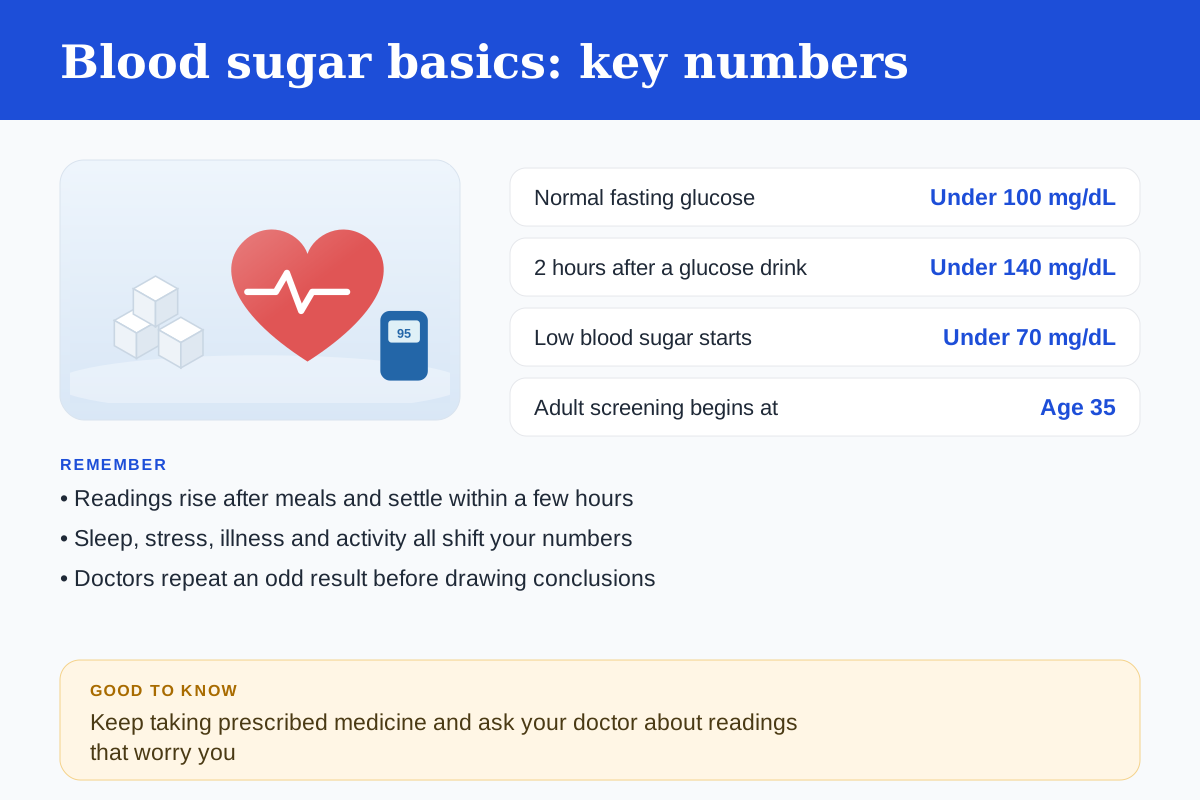
| Fasting plasma glucose | Under 100 mg/dL | 100 to 125 mg/dL | 126 mg/dL or higher |
| A1C | Under 5.7% | 5.7% to 6.4% | 6.5% or higher |
| 2-hour oral glucose tolerance test | Under 140 mg/dL | 140 to 199 mg/dL | 200 mg/dL or higher |
The fasting test measures glucose after you have gone without food overnight, so it is usually drawn first thing in the morning. A result under 100 mg/dL is considered normal.
The A1C test works differently. It measures how much glucose has stuck to hemoglobin, the oxygen-carrying protein in red blood cells. Because red blood cells live for months, A1C reflects your average blood sugar over the past few months and isn't thrown off by what you ate yesterday. You don't need to fast for it. Normal is below 5.7%.
The oral glucose tolerance test shows how your body handles a set dose of sugar. You fast, drink a sweet glucose solution, and have blood drawn two hours later. Under 140 mg/dL is normal. It takes a couple of hours in the clinic, so doctors tend to order it when other results are borderline or unclear.
What happens to blood sugar after a meal
A rise after eating is normal and expected. How high it goes, and how quickly, depends mostly on the meal. White bread, sweetened cereal, juice and soda are digested fast and push glucose up quickly. Meals with more fiber, protein and some fat slow digestion, so the rise is gentler and more spread out. In a healthy body the level comes back toward its starting point within a few hours.
You may see after-meal numbers mentioned online. For people who already have diabetes, the ADA's general targets are 80 to 130 mg/dL before meals and under 180 mg/dL one to two hours after the start of a meal. Those are treatment goals a doctor adjusts for each patient, and they aren't meant as a test for people who feel well. If you have never been told to check your blood sugar at home, the lab tests in the table above are a better guide.
Low blood sugar: the other end of the range
The NIDDK describes a blood glucose level below 70 mg/dL as low, a condition called hypoglycemia. In people without diabetes it is uncommon. It happens most often in people who take insulin or certain glucose-lowering pills, especially after a skipped meal, extra exercise or alcohol.
Early signs include shakiness, sweating, a fast heartbeat, sudden hunger, irritability and trouble thinking clearly. For people on those medicines, the NIDDK advises taking 15 to 20 grams of fast-acting carbohydrate, such as glucose tablets or gel, then checking again after 15 minutes and repeating if the level is still low. Anyone who has these episodes should tell their doctor, because the medicine plan may need to change.
Some herbs and supplements sold for blood sugar support can add to the effect of glucose-lowering medicine. That is one more reason to tell your doctor or pharmacist about everything you take, including capsules bought online.
Everyday things that push your numbers up or down
Blood sugar responds to far more than dessert. These are the common day-to-day influences:
- The amount and type of carbohydrate in a meal, and whether it comes with fiber and protein.
- Physical activity. Working muscles take up glucose, and a brisk walk can bring a reading down for some time afterward.
- Stress. Hormones such as cortisol and adrenaline tell the liver to release more glucose.
- Short or broken sleep, which can make the body respond less well to insulin the next day.
- Illness and infection, which raise stress hormones in the same way.
- Some medicines, including steroid drugs such as prednisone.
- Alcohol, which can lower blood sugar in people who take insulin or certain diabetes pills, particularly on an empty stomach.
- Early morning hormones, which raise glucose a little before you wake up in many people.
Because so much feeds into one number, patterns over weeks tell you more than any single morning.
Getting checked: lab tests and home meters
The ADA now recommends that all adults be screened for prediabetes and diabetes starting at age 35. If results are normal, testing should be repeated at least every 3 years, or sooner if your risk factors change or symptoms appear. Adults who are overweight and have other risk factors, such as a parent or sibling with type 2 diabetes or high blood pressure, may be tested earlier. People already told they are in the prediabetes range are usually retested every year.
Screening matters because changes in blood sugar are often silent. According to the CDC, about 98 million American adults, roughly 1 in 3, have prediabetes, and more than 8 in 10 of them don't know it.
Home meters and continuous glucose monitors are useful for people whose doctor has asked them to track readings. If you use one out of curiosity, keep in mind that a fingerstick reading taken right after lunch will look very different from a fasting lab value. Write down the time, what you ate and how you felt, and take the log to your next appointment instead of drawing conclusions on your own.
When to see a doctor
Book an appointment if you notice any of these:
- Being very thirsty or urinating much more often than usual
- Blurry vision
- Tiredness that doesn't lift with rest
- Cuts or sores that heal slowly
- Weight loss you can't explain
- Tingling or numbness in the hands or feet
- Episodes of shakiness, sweating or confusion that ease after eating
You should also ask about a blood sugar test if it has been more than 3 years since your last one, if a home reading taken while fasting comes back at 100 mg/dL or more on more than one morning, or if you had high blood sugar during a pregnancy.
Get urgent care for confusion, fainting, vomiting with very high readings, or trouble breathing. If you already have diabetes, keep taking your prescribed medicine and contact your care team whenever your readings start to look different from your usual pattern.
Where a supplement like GLPro fits
GLPro is a once-a-day capsule sold as a blood sugar support supplement. According to the GLPro team, its listed ingredients are berberine, chromium, cinnamon bark, alpha lipoic acid and bitter melon. Each of these has been studied for its role in normal glucose metabolism, but the brand doesn't publish the amount of any ingredient, so nobody outside the company can compare the formula with the doses used in research.
It is a supplement, so it can't diagnose, treat or replace medical care, and it won't change what your lab numbers mean. Some people like to pair healthy habits with a supplement for blood sugar levels that are already in the normal range. If that is you, check with your doctor first, especially if you take any prescription medicine. The bottle comes with a 60-day money-back guarantee. We cover the ingredients, price and drawbacks in our full GLPro review.
Whatever you decide about supplements, the most useful step is knowing your own numbers. A yearly checkup and a fasting glucose or A1C test when your doctor recommends it will tell you far more than any single reading at home.
Frequently asked questions
What is a normal blood sugar level in the morning before breakfast?
A fasting blood glucose level under 100 mg/dL is considered normal. Readings from 100 to 125 mg/dL fall in the prediabetes range, and 126 mg/dL or higher is in the diabetes range, which doctors confirm with repeat testing. One high reading at home is worth mentioning to your doctor, who can order a proper lab test.
Is it normal for blood sugar to go up after eating?
Yes. Blood sugar rises after every meal that contains carbohydrate, then falls back as insulin moves glucose into your cells, usually within a few hours. Meals with more fiber, protein and healthy fat tend to produce a slower, smaller rise than sugary drinks or refined starches.
Can stress or poor sleep change my blood sugar readings?
They can. Stress hormones such as cortisol and adrenaline signal the liver to release extra glucose, and short sleep can make the body respond less well to insulin. Illness and some medicines, such as steroids, can raise readings too. That is why doctors look at patterns and lab tests rather than a single number.
How often should adults get their blood sugar checked?
The American Diabetes Association recommends screening for all adults starting at age 35, repeated at least every 3 years if results are normal. Your doctor may test earlier or more often if you are overweight, have a family history of type 2 diabetes, or have had results in the prediabetes range. If you already have diabetes, follow your care team's schedule and keep taking your prescribed medicine.
Sources
- American Diabetes Association: Standards of Care, diagnosis and screening criteria
- American Diabetes Association: Glycemic targets
- CDC: About Prediabetes and Type 2 Diabetes
- CDC: Diabetes testing
- NIDDK: Low Blood Glucose (Hypoglycemia)
This guide is for general information and is not medical advice. Talk to your doctor about your own numbers and treatment.