Search for almost any popular supplement and the first page of results can look like a wall of praise: five-star ratings from tens of thousands of buyers, smiling customers, news-style articles and several sites that each call themselves the official store. Very little of it is what it appears to be.
This guide shows the common tricks, from stock photo customers to paid press releases, explains the federal rule on fake reviews that took effect in October 2024, and points to places where real buyer feedback tends to show up. We use our own research on GLPro as a worked example.
Why supplement reviews are so easy to fake
Many supplements are sold through affiliate programs. A seller pays a commission to anyone who sends a buyer, so thousands of websites have a reason to rank for the product's name and push readers to the checkout. Some of those sites are honest. Others copy the sales page, add a star rating and a few glowing testimonials, and buy a domain that looks official.
Supplements are also hard to judge from experience. Effects tend to be subtle and slow, and people rarely know what would have happened without the product. That makes a page full of confident success stories persuasive, whether or not those buyers exist.
Fake customers and inflated ratings
Stock photo customers
Testimonials often come with a friendly face and a first name with a city. Many of those faces are stock photos sold to anyone. A reverse image search (in Google Images or Bing Visual Search) often finds the same face on unrelated sites, sometimes with a different name. Read the small print too: some sales pages state in their terms that testimonials come from actors or voice actors or describe results that are not typical.
Huge review counts in schema
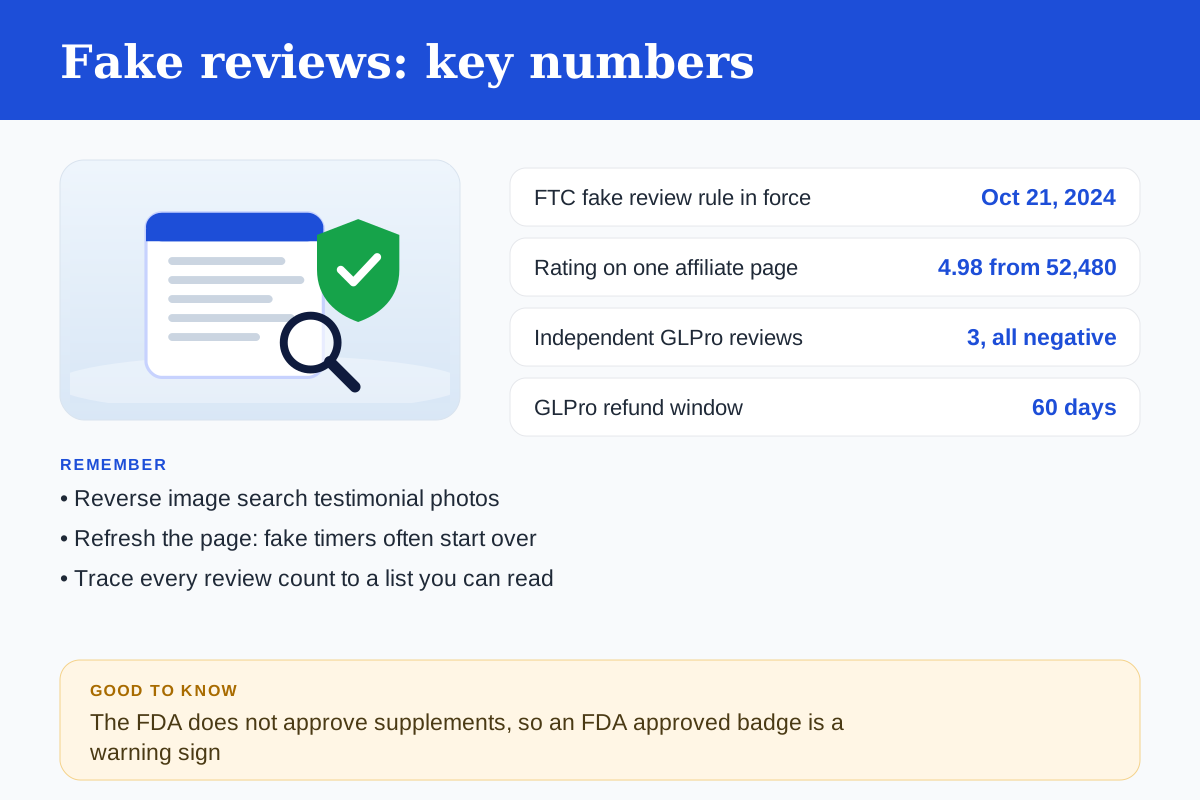
Some pages add hidden code called schema markup so search engines show stars next to the link. Nothing checks that the rating is real. Some affiliate pages for GLPro display ratings like 4.98 from 52,480 reviews, with no link to where those reviews live. Ask where you can read them. A real count should lead to a real list you can scroll, sort and filter, with dates and some low ratings mixed in.
Pressure tactics, paid articles and lookalike sites
"Just bought" popups, viewer counters and timers
A small box saying "Linda from Ohio just bought 6 bottles" or "71,712 people watching now," and a countdown that says the deal expires in 29 minutes, are pressure tools. Refresh the page or open it in a private window: if the timer starts over or the same names cycle through, the urgency is built into the page. A real discount does not usually vanish in half an hour.
Paid press releases
Articles on newswire sites and syndicated "news" pages look like journalism, but many are paid placements written by marketers. Look for a line near the bottom saying the content is sponsored or that the publisher may earn a commission, and for a distribution service named in the byline.
Invented "Reddit users say" lines
Some pages quote what "Reddit users" or "customers on forums" supposedly said, without a single link to an actual thread. If a quote can't be traced to a dated post by a named account, treat it as copywriting.
Lookalike "official" websites
Several sites can claim to be the official store for one product, using the brand name plus words like "us," "usa," "official" or a slight misspelling. Some only redirect you through chains of links; security tools flag others as unsafe. A badge reading "FDA approved" on a supplement is a clear warning sign, because the FDA does not approve dietary supplements before they are sold.
The FTC rule on fake reviews
In August 2024 the Federal Trade Commission announced a final rule banning fake reviews and testimonials, and it took effect on October 21, 2024. Among other things, the rule prohibits:
- writing, selling or buying fake reviews or testimonials, including ones generated by AI or attributed to people who don't exist or never used the product
- paying or giving incentives for reviews that are required to be positive or negative
- reviews by company insiders, such as owners and employees, that don't disclose the connection
- company-controlled websites that claim to be independent review sites
- suppressing negative reviews through threats or false accusations
- selling or buying fake social media signals, such as bot followers or views
The rule lets the FTC seek civil penalties against businesses that knowingly break it, something the agency usually could not do for a first violation before. A rule does not clean up the internet overnight, but it gives buyers a place to report what they see: the FTC takes complaints at ReportFraud.ftc.gov.
Where to find real reviews
No source is perfect, but some are harder to fake than a sales page.
- Trustpilot, the Better Business Bureau and complaint sites such as PissedConsumer show dated reviews and, often, the company's replies. Check the spread of ratings, not just the average, and be wary of a burst of five-star posts on a single day.
- Large retail sites can help, but make sure the listing is the same product from the same seller. Copies and different formulas sometimes share a name.
- Real discussion threads have usernames, dates, follow-up questions and disagreement. A thread where everyone agrees in polished sentences is a warning sign.
- The FDA's warning letter and advisory letter pages show whether regulators have flagged a company's claims.
- Your pharmacist has no stake in the sale and can tell you whether an ingredient is a poor fit with your medicines.
Remember that even honest reviews are personal stories. They can tell you about shipping, refunds and side effects people noticed. They can't tell you whether a product will work for you or whether it is safe with your medicines. For anyone with a health condition or taking prescription medicine, the doctor's advice comes first, and prescribed medicine should be continued as directed.
A checklist you can use on any product
| Check | Warning sign | Better sign |
|---|---|---|
| Star rating | Near-perfect score from tens of thousands, nowhere to read them | A visible list of dated reviews with mixed ratings |
| Customer photos | Faces that appear on other sites in a reverse image search | Ordinary photos, specific details, some complaints |
| Urgency | Countdown timer, "just bought" popups, viewer counters | A stable price you can come back to |
| Website | Brand name plus "us," "official" or a misspelling | One checkout linked from the brand's own contact details |
| News coverage | Press releases and sponsored articles | Reporting by a named journalist at an independent outlet |
| Forum quotes | "Reddit users say" with no link | Real threads with usernames and dates |
| Badges | "FDA approved" on a supplement | A USP or NSF mark you can confirm on the certifier's site |
| Regulator records | Warning or advisory letters about claims | No letters, and claims limited to body functions |
If you already bought from a page like this
Check your bank or card statement against the order you meant to place, since add-on offers at checkout can raise the total. Save the order confirmation and the seller's refund terms, and note the deadline. If the label on the bottle differs from what the page promised, or you notice side effects, stop taking it and talk to your doctor or pharmacist; serious side effects can also be reported to the FDA through its MedWatch program. Fake reviews and misleading pages can be reported to the FTC.
What we found for GLPro
When we researched GLPro in November 2026, we looked for independent buyer feedback on Trustpilot, PissedConsumer, Sitejabber, the BBB, Reddit and YouTube. We found three independent reviews on two sites, and all three were negative. We found no independent positive review.
- On Trustpilot, a page for "GLPro Blood Sugar" had two reviews, rated 1 and 2 stars, from US buyers between May and August 2026. One reviewer said they saw no change in their blood sugar after about five months. The other said they saw no change after two weeks and that an add-on deal at checkout pushed their order to over $600.
- On PissedConsumer, one buyer posted a complaint in June 2026 about a six-bottle order, describing swelling and fatigue that she connected to the product and asking for a refund. Her health claims are her own and we could not verify them. BuyGoods, the retailer, replied that it had processed a full refund and asked her to return the bottles at her own cost.
Three reviews is a very small sample, so it can't tell you how most buyers fare. It does show the gap between what independent buyers wrote and the large ratings some affiliate pages display.
The official sales page also uses several of the tactics above, including a viewer counter, a countdown timer and "just bought" popups, and its terms mention actors and testimonials that may not be typical. Regulators have looked at the marketing too. On May 1, 2026, the FDA sent GLPro an online advisory letter saying its websites "recommend or suggest" the products "to treat or prevent diabetes mellitus."
On the positive side, the product has a real checkout through BuyGoods and ClickBank and a 60-day refund window, and its listed ingredients have been studied for normal glucose metabolism. We weigh all of it in our GLPro review.
Frequently asked questions
How can I tell if a supplement testimonial is fake?
Run a reverse image search on the customer photo, look for specific details such as dates and dosing, and read the site's terms for words like actor or results not typical. Testimonials with no way to contact or verify the person deserve little weight.
Are fake reviews illegal in the US?
The FTC's final rule on fake reviews and testimonials, announced in August 2024, took effect on October 21, 2024. It bans buying, selling and writing fake reviews, undisclosed insider reviews and fake social media signals, and it lets the FTC seek civil penalties against businesses that knowingly break it.
How do I find the real official website for a supplement?
Look for the address that the brand's own labels, receipts and customer service use, and be wary of domains that add words like official, us or usa or misspell the name. Avoid any site that shows an FDA approved badge on a supplement.
Can reviews tell me if a supplement is safe for me?
No. Reviews are useful for shipping, refunds and side effects people noticed, but only your doctor or pharmacist can judge a supplement against your health and medicines. Keep taking any prescribed medicine, including medicine for diabetes, and ask before adding a supplement.
Sources
- FTC: Federal Trade Commission announces final rule banning fake reviews and testimonials (August 2024)
- FTC: Trade Regulation Rule on the Use of Consumer Reviews and Testimonials, 16 CFR Part 465
- FDA: GLPro online advisory letter, May 1, 2026
- FDA: Questions and answers on dietary supplements
- Trustpilot: GLPro Blood Sugar reviews page
- PissedConsumer: GLPro complaint, June 2026
This guide is for general information and is not medical advice. Talk to your doctor about your own numbers and treatment.