Turn almost any supplement bottle around and you will find a small box headed Supplement Facts. It is the most useful part of the package, and most people skip it in favor of the big promises on the front.
This guide walks through that box line by line: serving size, amounts, Daily Values, ingredient forms, the "other ingredients" list and the proprietary blend, a format that tells you what is inside but not how much. It also explains what third-party seals do and don't prove, and what to do when a product's label isn't published at all.
What US rules require on a supplement label
The FDA sets the labeling rules for dietary supplements, but it does not approve supplements or their labels before they go on sale. The company is responsible for making sure the label is accurate. A compliant label has a few required parts:
- a statement of identity, meaning the product name plus the words "dietary supplement" or a term such as "herbal supplement"
- the net quantity, for example 30 capsules
- the Supplement Facts panel
- an "other ingredients" list for anything not in the panel
- the name and place of business of the manufacturer, packer or distributor
Labels also carry a US address or phone number where people can report serious side effects. If the front of the bottle makes a claim about a body function, such as "supports healthy blood sugar," the label must also carry a standard disclaimer saying the FDA has not evaluated the statement and that the product is not intended to diagnose, treat, cure or prevent any disease.
The Supplement Facts panel, line by line
| Label part | What it tells you | What to check |
|---|---|---|
| Serving size | How many capsules make one serving | Whether the amounts listed are for one capsule or several |
| Servings per container | How long a bottle lasts at the listed serving | Real cost per day |
| Amount per serving | How much of each ingredient is in one serving | Compare with amounts used in research |
| % Daily Value | The amount as a share of the daily reference for nutrients that have one | Very high percentages, and stacking with a multivitamin |
| Ingredient form and plant part | Which chemical form or which part of a plant is used | Whether it matches the form that was studied |
| Proprietary blend | Total weight of a group of ingredients | How much room is left for each one |
| Other ingredients | Capsule shell, fillers, flow agents, colors | Allergens, gelatin if you avoid animal products |
| Manufacturer or distributor | Who stands behind the product | A real company name and contact details |
Start at the top with serving size. A label that says "serving size: 3 capsules" lists the amounts for all three together, so one capsule holds a third of each figure. That changes both the dose and the cost per day.
Next, look at amount per serving. Vitamins and minerals are listed in standard units such as micrograms (mcg) or milligrams (mg), usually with a % Daily Value. Herbal ingredients have no Daily Value, so you'll see an amount in milligrams followed by a symbol that means none has been set.
What a proprietary blend is
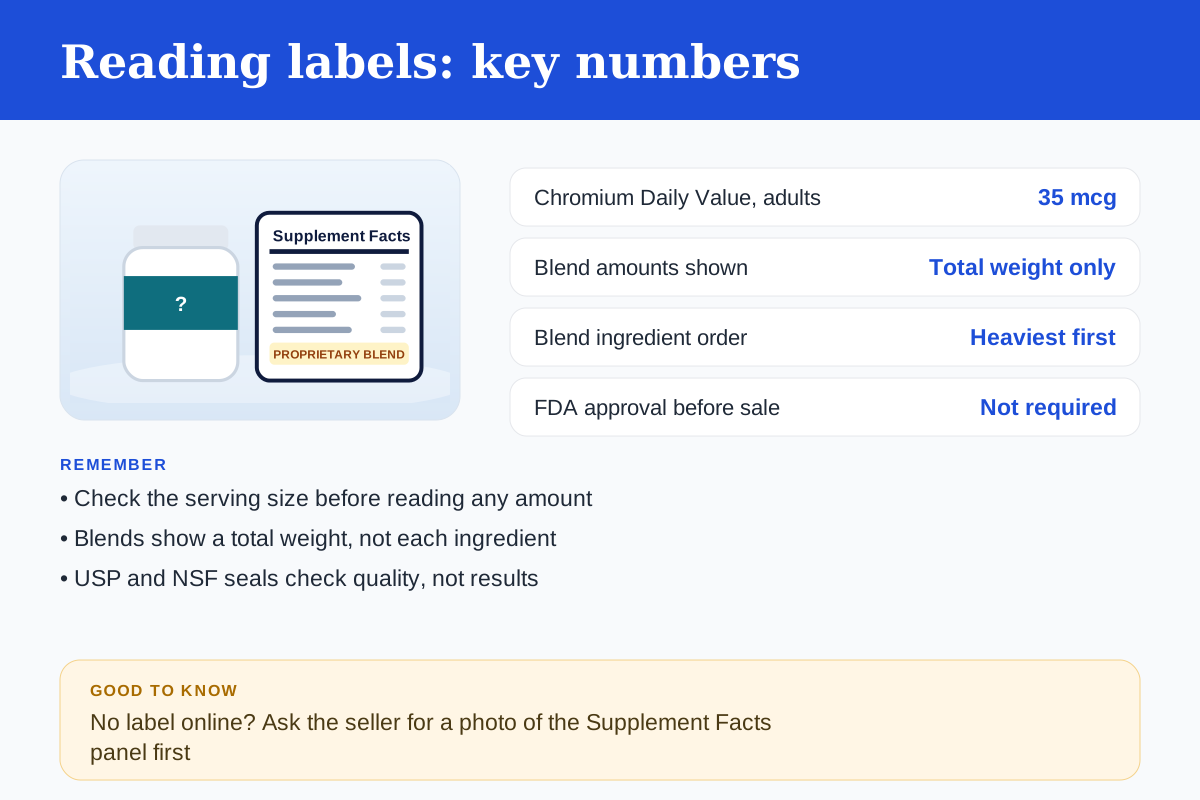
A proprietary blend is a group of ingredients listed under one name, often something like "Glucose Support Complex," with a single total weight. Under FDA rules the label must show the total weight of the blend, and the ingredients inside it must be listed in descending order by weight, from the most to the least. The label does not have to show the amount of each ingredient in the blend.
Companies say blends protect their formulas from copycats. For buyers the trade-off is simple: you learn what is in the blend and which ingredient is heaviest, but not how much of each one you are getting.
A little arithmetic helps. Say a blend weighs 500 mg and lists five herbs. The first ingredient could be 450 mg, leaving 50 mg for the other four combined. It could also be 101 mg, with the rest split almost evenly. If research on the fourth ingredient used 500 mg a day, there's no way that ingredient reaches that amount inside a 500 mg blend shared with four others.
Why doses matter
An ingredient name on a label tells you very little without an amount. Studies test particular doses, and an effect seen at one amount says nothing about a much smaller one. When a product lists only names, or hides amounts in a blend, you can't compare it with research, you can't check it against your doctor's advice, and you can't tell whether two products with the same ingredient list are anything alike.
Dose also matters for safety. Some ingredients interact with medicines, and the risk can depend on how much you take. A pharmacist can give much better advice when you can show the exact amount of each ingredient. Anyone taking prescription medicine, including medicine for blood sugar, blood pressure, thyroid or blood clotting, should check with their doctor or pharmacist before starting a new supplement and keep taking prescribed medicine as directed.
Forms and plant parts: reading the fine print
Many ingredients come in several forms, and a good label names the one used. Chromium is a common example. You may see chromium picolinate, chromium chloride, chromium polynicotinate or chromium yeast. The amount listed should be the elemental chromium in micrograms, and the NIH Office of Dietary Supplements gives a Daily Value of 35 mcg for adults.
Plant ingredients need even more detail. Look for the species, the part of the plant and whether it is a whole powder or an extract. "Cinnamon" can mean cassia or Ceylon cinnamon, which differ a lot in coumarin, a natural compound that can strain the liver at high intake. An extract may list a ratio such as 10:1, meaning ten parts of plant went into one part of extract, or a standardization such as "standardized to 97% berberine HCl." Those details tell you far more than the plant name alone.
Third-party seals: what they mean
Because the FDA doesn't test supplements before sale, some companies pay independent groups to check their products.
- The USP Verified mark means the US Pharmacopeia has checked that the product contains the listed ingredients in the declared amounts, does not contain certain harmful levels of contaminants such as heavy metals, breaks down properly in the body, and was made following good manufacturing practices.
- NSF certification means NSF has tested that the contents match the label and audited the facility. NSF Certified for Sport adds batch testing for substances banned in sport, which matters to athletes who are drug tested.
A seal does not mean a product works or is right for you. It is a quality check. Also check the claim itself: both organizations list certified products on their websites, so you can search for the brand. Phrases like "made in an FDA registered facility" or "GMP certified" are different. FDA registration is a listing, not an approval, and a badge reading "FDA approved" on a supplement is a red flag, because the FDA does not approve supplements.
A quick label checklist
- Find the serving size and work out how many capsules a day the amounts refer to.
- Check that every active ingredient has an amount, or that any blend shows a total weight.
- Look for named forms (for example chromium picolinate) and named plant species and parts.
- Compare the amounts with what was used in research, which the NIH Office of Dietary Supplements fact sheets often list.
- Read the other ingredients for allergens and anything you avoid.
- Confirm a company name and a working contact.
- Look for a USP or NSF mark and confirm it on the certifier's site.
- Take a photo of the panel to your pharmacist if you take any medicine.
The NIH Office of Dietary Supplements also runs a free Dietary Supplement Label Database where you can look up the labels of many products sold in the US.
GLPro: when the label isn't published
GLPro is a useful example of a product you can't check this way before buying. The official sales page describes it only as a "proprietary blend of natural ingredients." According to the GLPro team, the listed ingredients are berberine, chromium, cinnamon bark, alpha lipoic acid and bitter melon, but we could not find a Supplement Facts panel, amounts, ingredient forms or the type of cinnamon anywhere online. Bottle images show 30 capsules, and the bottle counts on the order page suggest one capsule a day.
If you are considering it, ask the seller for a clear photo of the Supplement Facts panel before you order. The support contacts listed on the official site are the email [email protected] and the phone number +1 (720) 738-6364. Ask for the amount of each ingredient, the form of chromium, the type of cinnamon and the name of the manufacturer. If you have already ordered, read the panel on the bottle as soon as it arrives and share it with your pharmacist. The 60-day refund window gives you time, though the refund policy requires a return authorization and you pay the return shipping. You can read how we rated it in our GLPro review.
Frequently asked questions
Is a proprietary blend a bad sign?
Not always, but it limits what you can check. US rules require the blend's total weight and its ingredients in descending order by weight. They do not require the amount of each ingredient, so you can't compare the product with the doses used in research.
What does the serving size really tell me?
It tells you how many capsules or tablets the listed amounts refer to. If the serving is two capsules, each capsule has half of each amount shown. Use it with the servings per container to work out the real cost per day.
Does a USP or NSF seal mean a supplement works?
No. These seals are quality checks. USP Verified and NSF certification confirm, among other things, that the product contains what the label says and meets limits for certain contaminants. They say nothing about whether the product will help you. Confirm any seal on the certifier's website.
What should I do if a supplement has no label online?
Contact the seller and ask for a photo of the Supplement Facts panel, the amount of each ingredient and the manufacturer's name before you buy. If you take prescription medicine, show the label to your pharmacist first, and keep taking your prescribed medicine as directed.
Sources
- FDA: Dietary Supplement Labeling Guide
- Code of Federal Regulations: 21 CFR 101.36, nutrition labeling of dietary supplements
- FDA: Questions and answers on dietary supplements
- NIH Office of Dietary Supplements: Chromium fact sheet
- NIH Office of Dietary Supplements: Dietary Supplement Label Database
- US Pharmacopeia: USP Verified mark
- NSF: Dietary supplement certification
This guide is for general information and is not medical advice. Talk to your doctor about your own numbers and treatment.