A few years ago almost nobody outside a lab had heard of GLP-1. Now it comes up at family dinners, on pharmacy signs and on supplement bottles. Some of those bottles, GLPro's included, carry the words 'Natural GLP-1 Booster' on the label, which leaves a lot of people wondering how a capsule relates to the injections their neighbor is taking.
This guide explains what GLP-1 is, what it does in your body, how prescription GLP-1 medicines work, and what the research on supplements and GLP-1 actually shows so far. It also covers the foods and habits linked to your body's own GLP-1 release. None of it replaces advice from your doctor, and anyone taking prescription medicine should keep taking it as directed.
What GLP-1 is
GLP-1 stands for glucagon-like peptide-1. It is a hormone your own body makes, mostly in specialized cells in the lining of the gut called L-cells. These cells are most common in the lower part of the small intestine and in the colon, though enough sit higher up in the intestine to produce an early rise in GLP-1 soon after you start eating.
When food reaches the gut, L-cells sense nutrients such as sugars, fats and protein breakdown products and release GLP-1 into the blood. Scientists group it with a second gut hormone, GIP, under the name incretins. Incretins are part of the reason your body releases more insulin when you eat glucose than when the same glucose is given straight into a vein: the gut tells the pancreas that a meal is on its way.
What GLP-1 does in the body
Once released, GLP-1 acts on several organs at once.
- It prompts the pancreas to release insulin, but only when blood glucose is raised. This glucose-dependent effect is one reason GLP-1 on its own rarely pushes blood sugar too low.
- It reduces the release of glucagon, a hormone that tells the liver to put more glucose into the blood.
- It slows the rate at which the stomach empties, so sugar from a meal reaches the bloodstream more gradually.
- It sends fullness signals to the brain, which can make you feel satisfied sooner.
The natural hormone works only briefly. An enzyme called DPP-4 breaks GLP-1 down very quickly after it is released, so its effects come in short bursts around meals. That detail explains much of the difference between the hormone your body makes and the medicines named after it.
How prescription GLP-1 medicines work
Drug makers designed molecules that act on the same GLP-1 receptors as the natural hormone while resisting breakdown, so they keep working for a day or a whole week instead of a few minutes. These are called GLP-1 receptor agonists. Examples include semaglutide (sold as Ozempic, Wegovy and Rybelsus), liraglutide (Victoza and Saxenda) and dulaglutide (Trulicity). Tirzepatide (Mounjaro and Zepbound) acts on both the GLP-1 and the GIP receptors.
These medicines went through clinical trials and FDA review before they could be sold. Depending on the product, they are approved for type 2 diabetes, for chronic weight management, or for both, and they are available only with a prescription. Most are injections given daily or weekly, and one form of semaglutide is a tablet. Common side effects include nausea, vomiting, diarrhea and constipation, and doctors adjust the dose slowly and monitor patients over time.
The FDA has repeatedly warned consumers about unapproved and compounded versions of semaglutide and tirzepatide sold online, including products with wrong ingredients, dosing errors or false claims of FDA approval. If you are considering a GLP-1 medicine, get it through a licensed prescriber and pharmacy.
What 'natural GLP-1 booster' supplements are
A growing number of supplements use GLP-1 language on the label. They usually contain plant extracts, minerals or fibers that someone believes may support the body's own GLP-1 release or the metabolic processes it affects. They contain no GLP-1 and no GLP-1 receptor agonist, and they are a different kind of product from the medicines above.
| Prescription GLP-1 medicine | 'GLP-1 booster' supplement | |
|---|---|---|
| What it contains | A drug that acts directly on GLP-1 receptors | Plant extracts, minerals or fiber |
| FDA review before sale | Yes, for safety and effectiveness | No, the FDA does not approve supplements before they are sold |
| How long it acts | A day to a week per dose | Any effect on GLP-1 would be small and short |
| Human evidence on GLP-1 effects | Large clinical trials | Early and limited |
| Can claim to treat a disease | Yes, for its approved uses | No |
| How to get it | Prescription only | Over the counter |
A supplement label can say a product supports a normal body function. It can't legally claim to treat, cure or prevent a disease, and the word 'GLP-1' on a bottle doesn't mean the product behaves like a GLP-1 drug.
What the research on supplements and GLP-1 shows so far
The honest answer is that it's early. Berberine, one of the ingredients in GLPro's listed formula, has been studied for its effects on glucose metabolism, and some laboratory and animal studies suggest it may influence GLP-1 secretion from gut cells. Human studies that measure GLP-1 directly after berberine are few and small. The same is true of most botanical ingredients marketed this way: there may be a plausible mechanism, but the human data are thin.
Fiber has a bit more behind it. Bacteria in the colon ferment certain fibers into short-chain fatty acids, and those compounds can stimulate L-cells. Most of this work comes from animal studies and small human trials, and the effects are modest.
Scale is the other thing to keep in mind. Prescription GLP-1 medicines produce receptor activity far beyond anything the body reaches on its own, and they last for days. A food or supplement that nudges your natural GLP-1 release after a meal is working within the normal range of your body's own signals. That may still be worthwhile as part of healthy habits, but it isn't comparable to a GLP-1 drug, and no supplement should be used in place of one.
Foods and habits linked to GLP-1 release
Your body releases GLP-1 every time you eat, and the type of meal seems to matter. Research in this area is still developing, but these patterns come up often:
- Fiber-rich foods such as oats, barley, beans, lentils, vegetables and whole fruit feed the gut bacteria that produce short-chain fatty acids.
- Protein from eggs, fish, poultry, yogurt, tofu or beans is a strong trigger for gut hormones linked to fullness.
- Healthy fats such as olive oil, nuts and avocado also stimulate L-cells and slow digestion.
- Eating vegetables and protein before the starchy part of a meal has been linked in small studies to a gentler rise in blood sugar after eating.
- Eating slowly gives fullness signals, GLP-1 among them, time to reach the brain before you have finished the plate.
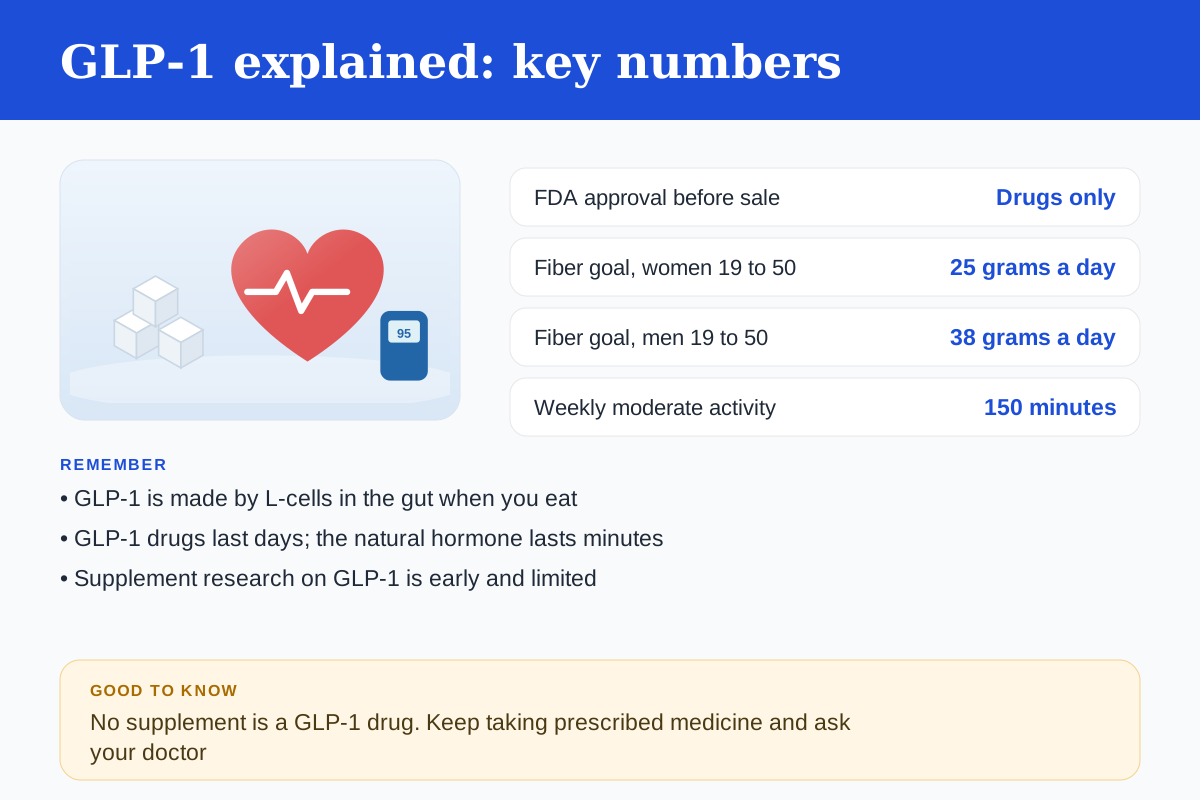
Fiber is the easiest of these to act on. MedlinePlus lists 25 grams a day for women and 38 grams a day for men aged 19 to 50, with slightly lower targets after 50. Raise your intake gradually and drink more water as you do, or you may feel bloated for a while.
Movement and sleep help too, though their link to GLP-1 itself is less clear than their effect on blood sugar overall. The CDC recommends at least 150 minutes a week of moderate activity such as brisk walking for adults, and at least 7 hours of sleep a night for adults up to age 60.
Who should talk to a doctor first
Check with your doctor or pharmacist before trying any supplement sold for blood sugar or GLP-1 support if you:
- take insulin, metformin, a sulfonylurea, a GLP-1 medicine or any other glucose-lowering drug
- take blood pressure, blood thinning or thyroid medicine
- are pregnant, breastfeeding or planning a pregnancy
- have kidney or liver disease
- have a planned surgery coming up
Several ingredients sold for blood sugar support, berberine and bitter melon among them, may add to the effect of glucose-lowering medicine and raise the chance of a low reading. Berberine also affects liver enzymes that process many drugs. If you have diabetes or think you might, see your doctor for testing, keep taking any prescribed medicine, and treat a supplement as something to discuss with your care team rather than a substitute for treatment.
Where GLPro fits
GLPro is a once-a-day capsule whose label says 'Natural GLP-1 Booster' and 'Supports your blood sugar'. According to the GLPro team, its listed ingredients are berberine, chromium, cinnamon bark, alpha lipoic acid and bitter melon. Each has been studied for its role in normal glucose metabolism, and berberine is the one with early research on GLP-1. The company does not publish ingredient amounts, and we have not seen any published study testing the GLPro formula itself for GLP-1 effects.
That makes it a dietary supplement that may support healthy blood sugar levels already in the normal range, sold with a 60-day money-back guarantee. It isn't a GLP-1 medicine and can't stand in for one. We look at the ingredients, pricing and limits in more detail in our GLPro review.
Frequently asked questions
Is GLP-1 the same thing as Ozempic?
No. GLP-1 is a natural hormone your gut releases when you eat. Ozempic is a brand of semaglutide, a prescription medicine that acts on the same GLP-1 receptors but is built to resist breakdown, so it works for about a week per dose instead of a few minutes. It is approved by the FDA for type 2 diabetes and is available only with a prescription.
Can a supplement work like a GLP-1 drug?
No supplement is a GLP-1 drug. Products labeled as natural GLP-1 boosters contain plant extracts, minerals or fiber, and the research on whether they raise GLP-1 in people is early and limited. At most they may nudge the body's own short-lived GLP-1 release, which is far smaller than the effect of a prescription medicine.
What foods help the body release GLP-1?
Meals that combine fiber, protein and some healthy fat are linked to stronger gut hormone responses. Good everyday choices include oats, barley, beans, lentils, vegetables, eggs, fish, yogurt, nuts and olive oil. Eating slowly and starting a meal with vegetables and protein may also help.
Can I take a GLP-1 booster supplement with my prescription medicine?
Ask your doctor or pharmacist first. Some ingredients in these products, such as berberine and bitter melon, may add to the effect of glucose-lowering medicine and raise the risk of low blood sugar, and berberine can change how the liver processes other drugs. Keep taking your prescribed medicine and never use a supplement to replace it.
Sources
- FDA: Concerns with unapproved GLP-1 drugs used for weight loss
- FDA: Questions and answers on dietary supplements
- MedlinePlus: High-fiber foods
- CDC: Adult activity, an overview
- CDC: About Sleep
- Review articles on incretin physiology (PubMed Central)
This guide is for general information and is not medical advice. Talk to your doctor about your own numbers and treatment.